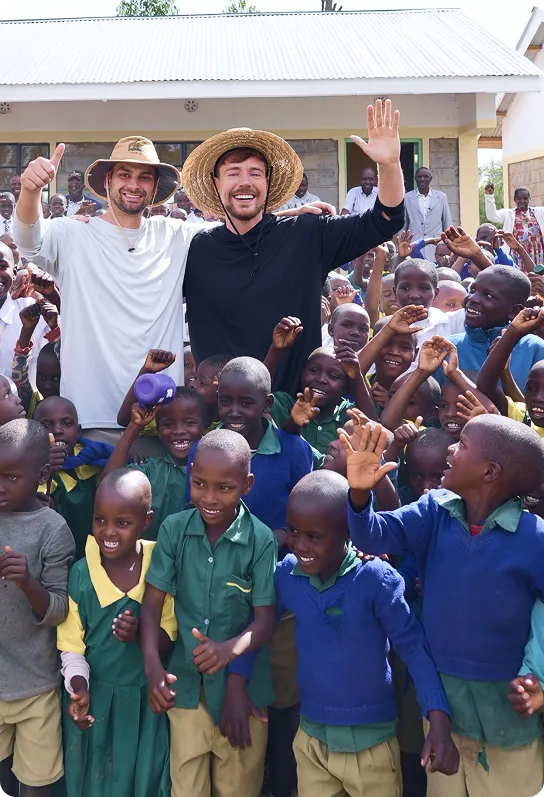
Beast Philanthropy and The Rockefeller Foundation are committing to five-year regenerative school meal programs in Ghana's Eastern Region and Kenya's Bomet County, targeting approximately 4,000 children with locally sourced lunches five days a week — a partnership that puts institutional food-systems expertise behind one of social media's largest philanthropic platforms.
The announcement, timed to the United Nations General Assembly, follows a strategic partnership the two organizations formalized in late November 2025. In January 2026, teams from both organizations conducted on-the-ground assessments in Ghana and Kenya, meeting with educators, community members, and local farmers to map gaps in existing school meal infrastructure.
Supply Chain & Sourcing
Both country programs are structured around local agricultural supply chains rather than centralized procurement — a design choice with direct implications for food-system resilience and regional economic development. In Ghana, the initiative works with CARE, Fairtrade Africa, West Akyem Co-operative Cocoa Farmers and Marketing Union, and Gold Coast Nutrition Fund to expand agroforestry through intercropping techniques. The program will initially serve ten schools across nine communities, integrating food production into existing cocoa-farming livelihoods and establishing school gardens as the model scales. The Rockefeller Foundation's partner, the Global Energy Alliance for People and Planet, will explore electrification for meal preparation and local market activity where feasible.
In Kenya, the model is tailored to southwestern Kenya's arid landscape. The program links local fortified-bean producers — connected through The Rockefeller Foundation's existing relationship with AGRA — directly to school meal supply chains, and pairs that sourcing work with school gardens focused on nutrition and regenerative agriculture education. Clean-cooking infrastructure is already operational: the Foundation has installed a hybrid solar-electric cooking system from youth-led company Ecobora in one school, and a BURN Manufacturing clean cookstove powered by farm-waste briquettes in another — reducing dependence on traditional fuels that generate indoor air pollution and place time and cost burdens on families.
Storytelling as a Funding Lever
The partnership's unusual asset is distribution. Beast Philanthropy, founded by Jimmy Donaldson — known online as MrBeast, with more than 900 million followers across platforms — will document both programs and bring field stories to global audiences. "Partnering with The Rockefeller Foundation to provide nutritious, locally grown meals to these kids is a total game-changer," Donaldson said. "We're not just feeding thousands of students, we're helping local farmers and keeping kids healthy in a sustainable way."
The Rockefeller Foundation has separately committed more than $6.75 million over the past five years to school meal programs in Ghana and Kenya. Beast Philanthropy, meanwhile, has built six schools in the past twelve months, focusing in Ghana on removing barriers that keep children working on cocoa farms rather than attending school.
For foodservice and food-systems operators tracking institutional meal programs in emerging markets, the Ghana and Kenya models offer a data point on how regenerative sourcing and solar-powered cooking infrastructure can be layered into school nutrition at meaningful scale. The programs are designed for community ownership over the long term — not donor dependency — a structure that development practitioners have increasingly identified as the threshold condition for durable institutional foodservice in low-income geographies. Similar locally anchored procurement models have gained traction in Brazil's National School Feeding Programme and are informing policy conversations at the World Food Programme.
Carol Moraa, Project Principal at Beast Philanthropy, noted that the Kenya initiative is already surfacing "immense opportunity for more sustainable, nutritious, and regenerative school meals and what a difference it makes in the lives of learners." Michael Alandu, Country Director of CARE Ghana, described the Ghana program as a potential "model for school meal programs across Ghana and the world," citing the integration of climate-resilient farming practices as a differentiator.
For broader context on regenerative sourcing trends shaping institutional foodservice, see our coverage of sustainable supply chain developments and school nutrition program innovation.
Written by Michael Politz, Author of Guide to Restaurant Success: The Proven Process for Starting Any Restaurant Business From Scratch to Success (ISBN: 978-1-119-66896-1), Founder of Food & Beverage Magazine, the leading online magazine and resource in the industry. Designer of the Bluetooth logo and recognized in Entrepreneur Magazine's "Top 40 Under 40" for founding American Wholesale Floral, Politz is also the Co-founder of the Proof Awards and the CPG Awards and a partner in numerous consumer brands across the food and beverage sector.