Nine o'clock on a Friday, and a good bar hums the way a good kitchen does: ice cracking into shakers, a bartender's wrist flicking a twist of citrus, the low roar of a room full of people deciding, without quite saying so, whether tonight is going to be a good one. It is a controlled kind of chaos, the same choreography that has always made hospitality feel like magic rather than transaction. What most patrons never clock, amid the citrus and the noise and the candlelight, is how much trust they are extending to a room full of strangers the moment they set a drink down and turn away from it.
Drink spiking happens far more often than most patrons assume, and the vast majority of incidents are never reported. Roughly 1 in 13 college students report having experienced a spiked drink, according to a 2016 study published in the journal Psychology of Violence that surveyed more than 6,000 students at three U.S. universities. A 2024 international survey of more than 7,600 nightlife-goers published in the Journal of Drug Issues found about one in five believed they had had a drink spiked at some point, most often in a club or bar. Those numbers sit uneasily against everything hospitality is built to promise: that a night out is safe to enjoy, that the room is looking out for you even when you are not looking out for yourself. For an industry that trades in good feeling, it is a gap worth taking seriously.
Justin Smith has built a company trying to close it. He is the founder and CEO of Cray, a Tampa-based dating and relationship safety platform, and its newest arm, Cray Protected, is aimed squarely at the rooms where food and beverage professionals spend their nights: bars, restaurants, and event venues looking to make patron safety something guests can see, not just something operators hope for.
Smith did not arrive at this work from a marketing meeting. He has spoken publicly about a relationship whose warning signs he only understood well after it ended, and about the years afterward spent picking apart why smart, careful people miss things that look so obvious in hindsight. His company's shorthand for the answer, now painted across its branding, is "vibes lie, patterns don't." A feeling in the moment, he argues, can talk a person out of what the facts have already been showing them. Smith brought a background in psychological assessment publishing and an MBA in entrepreneurship from the University of Tampa to the question, and spent that stretch of years turning a private blind spot into something closer to a field guide.
That field guide became the Cray app, which launched worldwide in October 2025. Users answer guided questions about a relationship, whether it is a date, a roommate, or a new friend, and the app measures those answers against a behavioral framework built from outside research: dozens of documented warning signs sorted into eighteen categories. The result comes back as a private CrayScore, alongside a second reading called SchemerScore that flags behavior aimed at getting something from someone, and a newer BaeScore that flips the exercise around to count what a relationship is doing right. None of it leaves the user's phone. There is no profile, no post, no one else who ever sees the answers. The app has since built partnerships with more than fifteen college campuses, where the same warning signs surface in dorm life as readily as they do in dating.
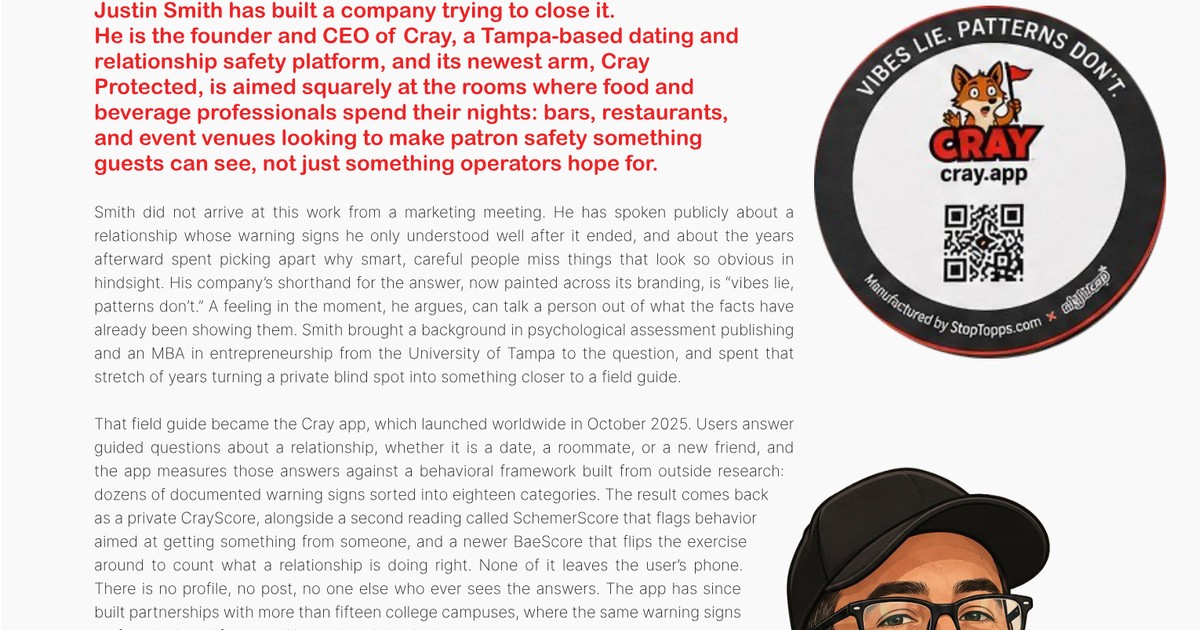
Cray Protected takes that same instinct and sets it loose in physical rooms, the ones where strangers actually meet: a bar on a Friday night, a restaurant hosting a first date, an event venue packed with people who do not yet know each other's names. The certification gives operators a badge and a kit built for the floor rather than a phone screen. Setup kits, priced from $99 for restaurants up to $229 for high-volume event spaces, include window decals, posters for the hallway and the restroom, and coasters that a patron can scan with a phone to reach the app mid-conversation. The kits also include NightCapIt, a peel-and-stick cover that seals a glass so nothing can be slipped into it while its owner is on the dance floor or in line for the restroom. Venues that burn through supplies faster than a one-time kit can keep up can put coasters and covers on a recurring shipment, with the price per unit easing down as the order grows.
The business case reads like something out of a P&L rather than a safety pamphlet. Visible safety measures give patrons another reason to come back to a venue, which turns a protective gesture into something closer to a loyalty program. And because the kits start at $99, the badge on the door is one of the cheapest visible commitments a venue can make to something guests were already inclined to want. There is a quieter argument too, the kind an insurance broker would recognize before a marketer would: posted signage, drink covers within reach at the bar, and staff trained to offer them are visible evidence that a venue has made patron safety part of how it operates—the kind of proactive commitment that guests, staff, and insurers alike tend to notice.
None of this asks a kitchen to cook differently or a bar to pour differently. The room still fills the way it always has, the citrus still gets twisted, the ice still cracks into the shaker right on cue. What changes is smaller and easier to miss unless you are looking for it: a badge by the door, a coaster on the table, a cover within arm's reach at the bar. Smith is betting that the next thing patrons remember about a night out will not be the drink list or the décor, but whether the room they walked into had already thought about their safety before they had to ask.
For kit details, pricing, or to place an order, visit cray.app/protected.