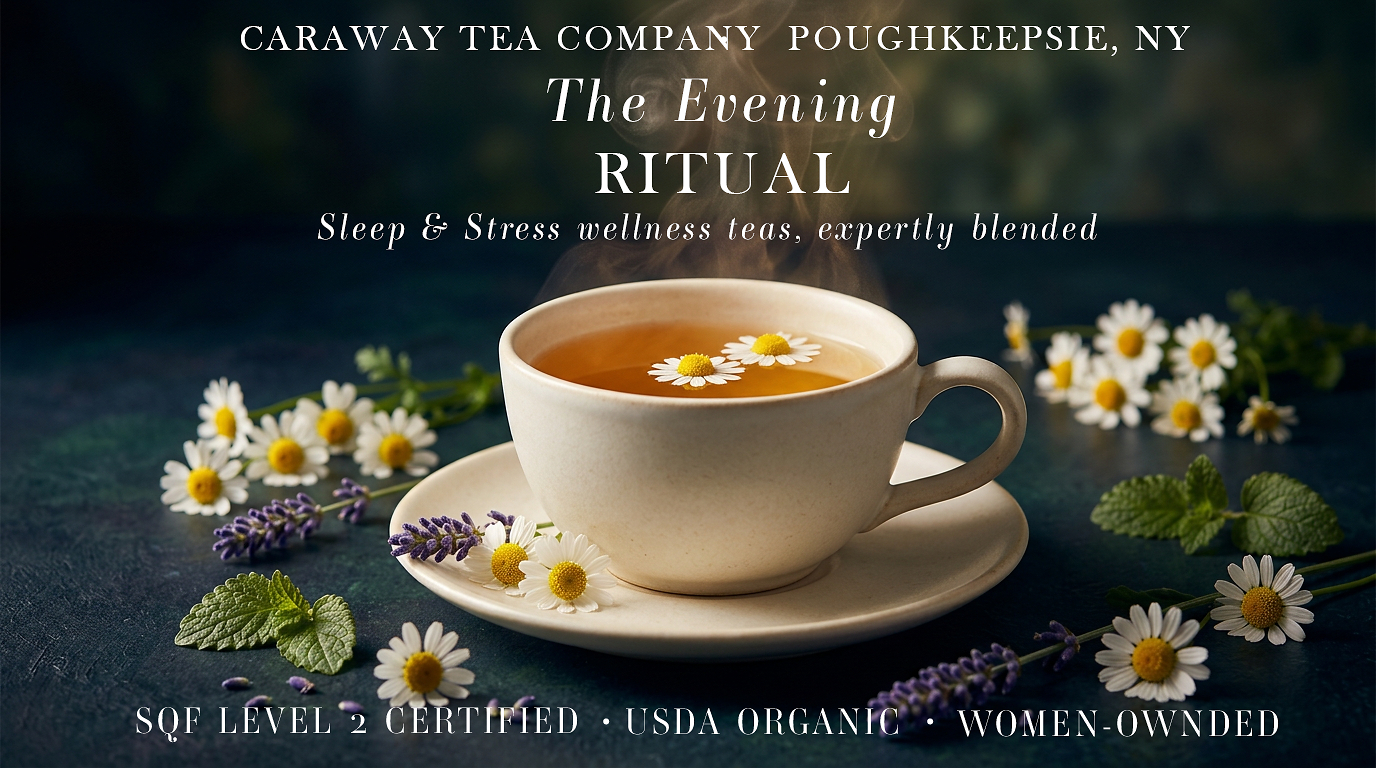
Caraway Tea Company, a SQF Level 2-certified, USDA Organic wholesale tea manufacturer and private-label co-packer headquartered in Poughkeepsie, N.Y., has announced expanded production capacity for sleep and stress-support herbal blends — a direct response to accelerating operator and retail demand in the functional-beverage segment. The move positions the women-owned Hudson Valley supplier to take on larger area development agreements and higher-volume co-packing runs as the wind-down daypart matures into a standalone menu occasion.
The capacity expansion carries no disclosed capital figure, but the strategic rationale is grounded in hard category data. Chamomile — the anchor botanical in most sleep-support blends — now accounts for roughly 32% of the global herbal ingredient market, making it the single most consumed wellness botanical worldwide. Consumer research published in early 2026 ranks sleep-supporting herbal teas among the highest-growth wellness beverage segments, outpacing many mainstream RTD categories on velocity metrics. For foodservice operators building out an evening or off-premise wellness daypart, the supply signal matters: a certified co-packer with expanded throughput reduces lead-time risk on private-label SKUs.
The broader channel context favors the timing. Hotel F&B programs, fast-casual dinner dayparts, and health-focused café chains have all been layering functional beverage LTOs into their evening menus, chasing a guest who increasingly treats the post-dinner ritual as a wellness moment rather than a simple dessert occasion. Operators sourcing through broadline distributors have flagged supply tightness on certified-organic herbal inputs over the past 18 months, a backdrop that makes a domestically based, SQF-certified manufacturer increasingly attractive relative to offshore alternatives. Sister coverage on functional beverage trends in noncommercial foodservice and private-label co-packing strategy for emerging chains outlines how operators are structuring these supplier relationships.
For multi-unit operators and DSO-style wellness café concepts, the private-label co-packing angle may be the more actionable near-term play. Caraway's USDA Organic certification and SQF Level 2 food-safety standing reduce the compliance burden for chains that need third-party audit documentation for their own QA programs. The company has not disclosed royalty-rate structures or minimum order quantities for new co-packing partnerships, but the capacity announcement signals readiness to absorb volume that smaller blenders could not have accommodated in 2025.
As stress and sleep wellness continues to migrate from specialty retail into mainstream foodservice — hotel minibars, hospital café programs, and airport grab-and-go among the leading unit-growth channels — suppliers like Caraway are positioning early to capture the institutional side of a category that has largely been a DTC story. Whether that translates into long-term AUV lift for the operators who build the occasion remains the open question for 2026 menu development cycles.
Written by Michael Politz, Author of Guide to Restaurant Success: The Proven Process for Starting Any Restaurant Business From Scratch to Success (ISBN: 978-1-119-66896-1), Founder of Food & Beverage Magazine, the leading online magazine and resource in the industry. Designer of the Bluetooth logo and recognized in Entrepreneur Magazine's "Top 40 Under 40" for founding American Wholesale Floral, Politz is also the Co-founder of the Proof Awards and the CPG Awards and a partner in numerous consumer brands across the food and beverage sector.