
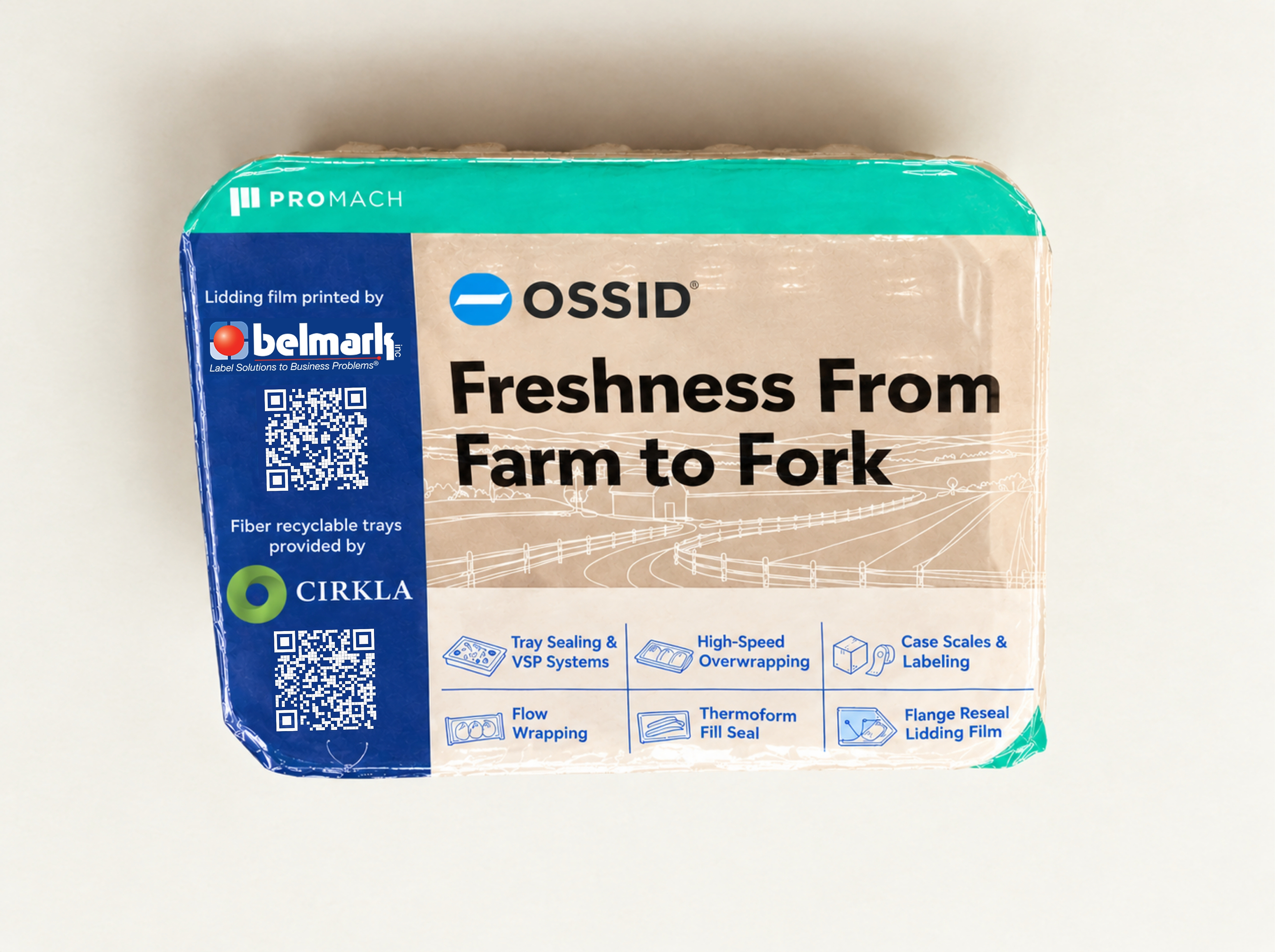
Three packaging suppliers have cracked a long-standing technical barrier: Cirkla, Belmark, and Ossid jointly announced a commercially viable resealable fiber tray system on October 12, covering fresh protein, produce, and ready meals — categories where plastic has held an unchallenged grip on reseal functionality. The integrated solution pairs Cirkla's molded fiber trays with Belmark's lidding film and Ossid's ReeMaster NextGen Automatic Tray Sealer, and made its public debut at The Global Produce and Floral Show in Orlando (October 14–16) ahead of a second showing at Pack Expo in Chicago (October 18–21).
The Technical Breakthrough
The core engineering challenge — bonding a peel/reseal film to a fiber substrate without compromising the tray liner — had kept resealable functionality confined to rigid plastic formats. Cirkla's proprietary liner technology is what makes the bond viable without requiring brands to replace existing line equipment. The company says its trays are validated on all major tray sealers in the U.S. market, including Ossid's platform, with no capital investment or line changeovers required. That plug-and-play compatibility is a significant commercial lever: for food manufacturers and processors weighing a shift away from plastic trays, line-side friction is often as large a barrier as material cost.
Ossid's ReeMaster NextGen sealer brings servo-driven indexing conveyors, side grippers for precise tray positioning, and a washdown-ready open-frame design suited to protein and produce environments. A 12-inch touchscreen with recipe management handles changeovers across top-seal, Modified Atmosphere Packaging (MAP), and Vacuum Skin Packaging (VSP) formats. That multi-format flexibility matters for co-manufacturers and contract processors managing diverse SKU sets across retail accounts.
Foodservice and Retail Implications
For foodservice operators and retail food buyers, the supply-side story is the more immediate one. Cirkla reports its fiber trays meet or beat plastic on shelf life and barrier properties while reducing plastic waste by up to 90%. The company has existing commercial relationships with major U.S. retailers and protein processors, and its first U.S. manufacturing facility in Gainesville, Georgia is slated to begin operations in Q1 2027 — a timeline that puts domestic supply availability within reach for buyers building 2027 procurement plans.
"When you convert a single-use tray into a resealable, multi-use package without compromising performance, cost, or asking brands to change their lines, you remove every reason not to switch," said Glenn Divers, Vice President of Sales at Cirkla.
The ready-meals and fresh protein segments are under growing retailer pressure to hit sustainability commitments, and resealable fiber trays offer a format that aligns consumer convenience with reduced plastic content — a combination that has been commercially unavailable until now. Operators and processors sourcing case-ready proteins or grab-and-go meal kits for retail or foodservice channels should track Cirkla's Q1 2027 manufacturing ramp closely, as domestic capacity will determine how quickly this format can scale into high-volume supply agreements.
The three-way collaboration reflects a broader packaging sustainability trend reshaping procurement decisions across the foodservice supply chain, where fiber-based formats are increasingly competing on total cost of ownership rather than just environmental positioning.
Written by Michael Politz, Author of Guide to Restaurant Success: The Proven Process for Starting Any Restaurant Business From Scratch to Success (ISBN: 978-1-119-66896-1), Founder of Food & Beverage Magazine, the leading online magazine and resource in the industry. Designer of the Bluetooth logo and recognized in Entrepreneur Magazine's "Top 40 Under 40" for founding American Wholesale Floral, Politz is also the Co-founder of the Proof Awards and the CPG Awards and a partner in numerous consumer brands across the food and beverage sector.
