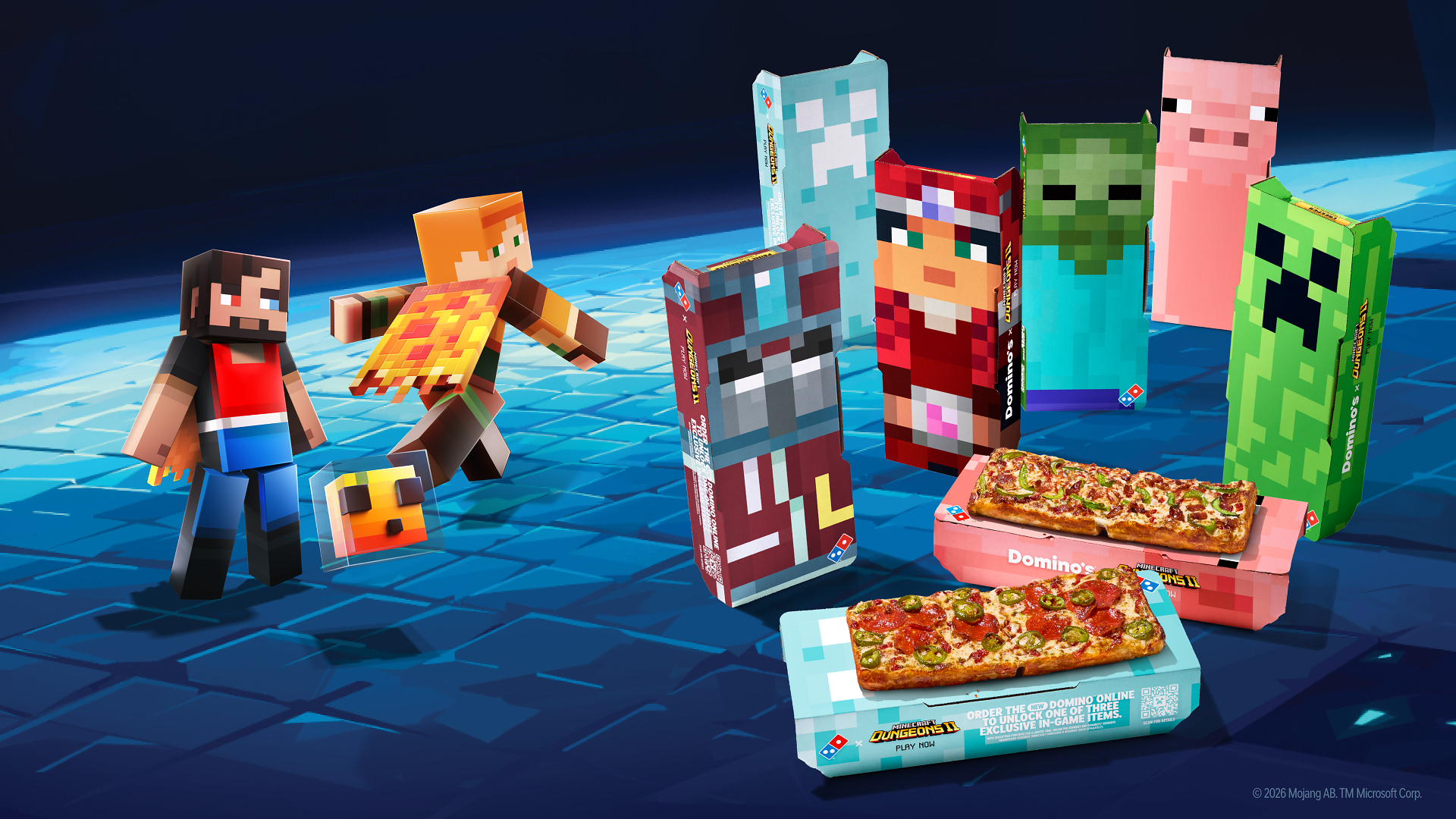
Domino's Pizza (Nasdaq: DPZ) is using the Oct. 26 launch of Minecraft Dungeons II as a vehicle to drive trial of its Domino, the made-for-one, block-shaped pizza the chain introduced earlier this year. The co-branded activation — the first brand partnership for the Minecraft Dungeons II title — runs in 19 international markets simultaneously, making it one of the chain's broader LTO rollouts in recent memory.
The Activation Mechanics
The promotion layers four distinct consumer touchpoints onto a single SKU purchase. Customers who buy a Domino receive one of six collectible Minecraft Dungeons II-themed boxes featuring characters including Corrupted Creeper, Prime Enchanter, Valorie, Zombie, Pig, and Creeper. Domino's Rewards members who purchase the product online unlock one of three randomly awarded in-game items — a branded avatar skin, a Slice Slayer cape, or a Cheesy Cube companion pet, the latter described as the first co-branded partnership pet in the Minecraft Dungeons II universe. Promo codes load directly into the member's "My Rewards" tab, tightening the loop between purchase frequency and loyalty program engagement.
The game-code giveaway runs Oct. 26 through Nov. 4, distributing 2,000 digital copies of Minecraft Dungeons II (Standard Edition, a $29.99 value) per day for a total of 20,000 codes, redeemable on PC and Xbox. Customers must submit proof of purchase at dominos.com/minecraft-dungeons-ii to enter. A branded, interactive Domino's Tracker skinned in Minecraft Dungeons II theming is also slated to launch, adding an order-status touchpoint to the campaign.
Why the Domino SKU Is the Anchor
Tying the entire promotion to the Domino rather than the chain's broader menu is a deliberate unit-economics play. The made-for-one format targets solo dining and snacking occasions — dayparts where Domino's has historically ceded share to convenience and fast-casual competitors — while the gaming hook positions the product squarely in the evening and late-night daypart where younger, digitally native consumers index heavily. Kate Trumbull, Domino's executive vice president and chief marketing officer, noted the block shape of the Domino made the creative integration feel organic: "With its block shape and customizable toppings, it felt right at home in the game's action-packed universe."
For a chain that generated more than 85.0% of U.S. retail sales through digital channels in 2025 and operates more than 22,700 stores across 90-plus markets, gaming-adjacent promotions represent a natural fit for the customer acquisition funnel. Co-branded LTOs that gate loyalty rewards behind digital purchases also generate first-party data and drive Domino's Rewards enrollment — metrics that carry increasing weight in a franchise system where 99.0% of units are independently owned and operators scrutinize marketing ROI closely.
The global footprint of the campaign — spanning Australia, Canada, Japan, Germany, Brazil, Saudi Arabia, and 13 additional markets — reflects Domino's asset-light international expansion thesis and suggests the Domino SKU is being positioned as a globally scalable platform rather than a domestic test. For franchisees in those markets, co-branded packaging and digital-only in-game item delivery keep incremental unit costs manageable while the game-code giveaway draws incremental traffic.
Co-branded food and gaming activations have become a reliable traffic driver across the QSR segment, with competitors including Pizza Hut and Papa Johns testing similar entertainment tie-ins. Domino's move to anchor the campaign to a new, differentiated SKU — rather than a discounted core item — signals an intent to build longer-term menu equity around the Domino format while the gaming IP supplies short-term frequency. Operators tracking LTO performance and limited-time menu strategy will want to watch whether the Domino's Rewards redemption data from this window informs future daypart targeting. For broader context on how QSR chains are using loyalty mechanics to protect same-store sales momentum, the Minecraft Dungeons II activation offers a useful case study in purchase-gated digital reward structures.
Written by Michael Politz, Author of Guide to Restaurant Success: The Proven Process for Starting Any Restaurant Business From Scratch to Success (ISBN: 978-1-119-66896-1), Founder of Food & Beverage Magazine, the leading online magazine and resource in the industry. Designer of the Bluetooth logo and recognized in Entrepreneur Magazine's "Top 40 Under 40" for founding American Wholesale Floral, Politz is also the Co-founder of the Proof Awards and the CPG Awards and a partner in numerous consumer brands across the food and beverage sector.