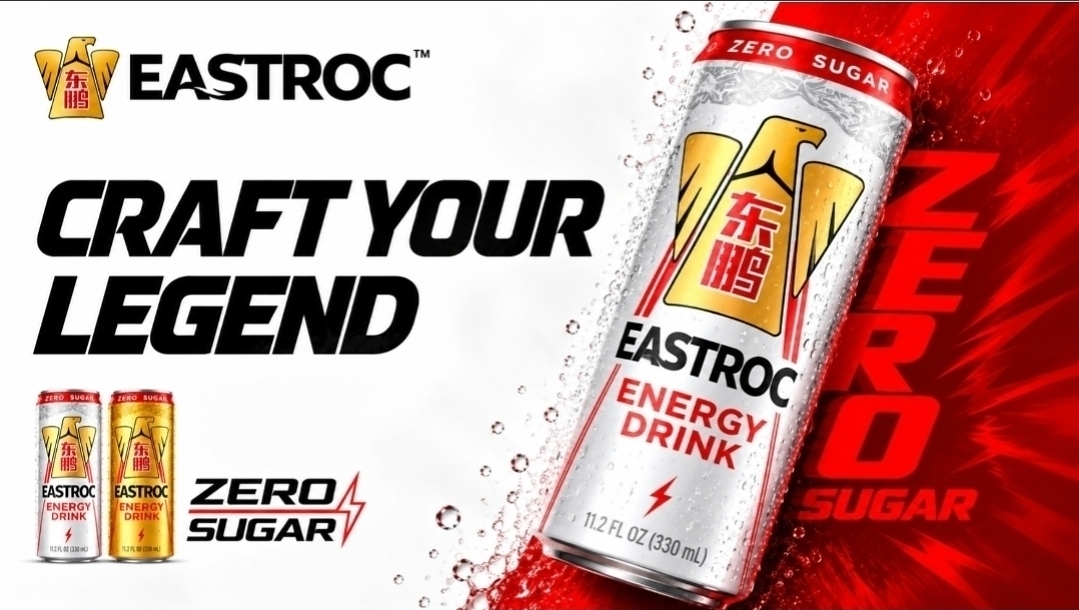
Chinese beverage manufacturer Eastroc Beverage is pushing into the U.S. energy drink segment with two launch SKUs — Gold and White Zero Sugar Energy cans — co-manufactured at Pittston Co-Packers in Pittston, Pennsylvania, with distribution and field sales infrastructure already activating in the market.
Leading commercial development is Joey Nickell, Chief Sales Officer of Eastroc North America and Chief Sales Officer of Pittston Co-Packers. Nickell's résumé includes executive roles at Coca-Cola and Bang Energy, two operators that defined the modern energy category's retail and distributor playbook at very different scales.
The Operator Footprint
Eastroc's global manufacturing base is substantial by any standard. As of June 30, 2026, the company operates 12 production facilities in China and exports to 36 countries and regions, covering research and development, packaging, quality management and distribution in-house. That vertical integration gives Eastroc cost leverage that many challenger brands cannot replicate — but it does not automatically translate to U.S. velocity, a lesson the energy category has taught repeatedly.
For U.S. manufacturing, Pittston Co-Packers serves as the domestic production partner, handling production and packaging services out of northeastern Pennsylvania. The arrangement gives Eastroc a domestic supply chain footprint — a meaningful differentiator as beverage importers continue to navigate tariff uncertainty and lead-time pressure on imported finished goods.
Category Context
The U.S. energy drink market remains one of the highest-velocity segments in non-alcoholic beverages, but shelf space is intensely contested. Monster Beverage and Red Bull collectively hold the majority of convenience-channel velocity, while Celsius has captured incremental distribution through grocery and club formats. Bang Energy's rise and subsequent bankruptcy reorganization illustrated that distribution scale alone does not guarantee brand durability — a point Nickell acknowledged directly, emphasizing repeat purchase and consumer demand creation over initial placement.
Zero-sugar positioning is strategically sound for the current environment. Better-for-you energy has been one of the fastest-growing subsegments, with operators and retailers alike expanding zero-sugar facings to meet consumer demand skewing toward lower-calorie functional beverages. Eastroc's White Zero Sugar SKU targets that trade-up shopper directly.
Pre-launch consumer exposure came through FanCon and VidCon activations, signaling a youth and creator-culture targeting strategy consistent with energy category norms. That channel — event sampling paired with influencer adjacency — has been a reliable trial-generation mechanism for emerging energy brands looking to build awareness outside traditional foodservice and convenience-channel demos.
What Operators Should Watch
For foodservice and convenience buyers evaluating new energy SKUs, Eastroc's pitch rests on three pillars: domestic co-packing continuity through Pittston, distributor development support, and merchandising investment. Nickell framed the brand's value proposition to trade partners around shared business-building — field execution, consumer engagement funding, and the kind of sell-through accountability that retailers increasingly demand before extending new facings.
Whether Eastroc can convert early trial into sustainable reorder rates will depend on how aggressively the company invests in distributor incentives and whether its marketing spend can sustain consumer pull in a daypart — mid-morning through mid-afternoon — that Monster, Red Bull, and Celsius have deeply conditioned. The non-alcoholic beverage segment is littered with well-capitalized entrants that stalled at regional scale; Eastroc's differentiated manufacturing infrastructure and Nickell's category experience are the clearest reasons to take the launch seriously. Watch distributor development agreements as the most reliable leading indicator of how broadly and quickly the brand can build U.S. velocity.
Written by Michael Politz, Author of Guide to Restaurant Success: The Proven Process for Starting Any Restaurant Business From Scratch to Success (ISBN: 978-1-119-66896-1), Founder of Food & Beverage Magazine, the leading online magazine and resource in the industry. Designer of the Bluetooth logo and recognized in Entrepreneur Magazine's "Top 40 Under 40" for founding American Wholesale Floral, Politz is also the Co-founder of the Proof Awards and the CPG Awards and a partner in numerous consumer brands across the food and beverage sector.