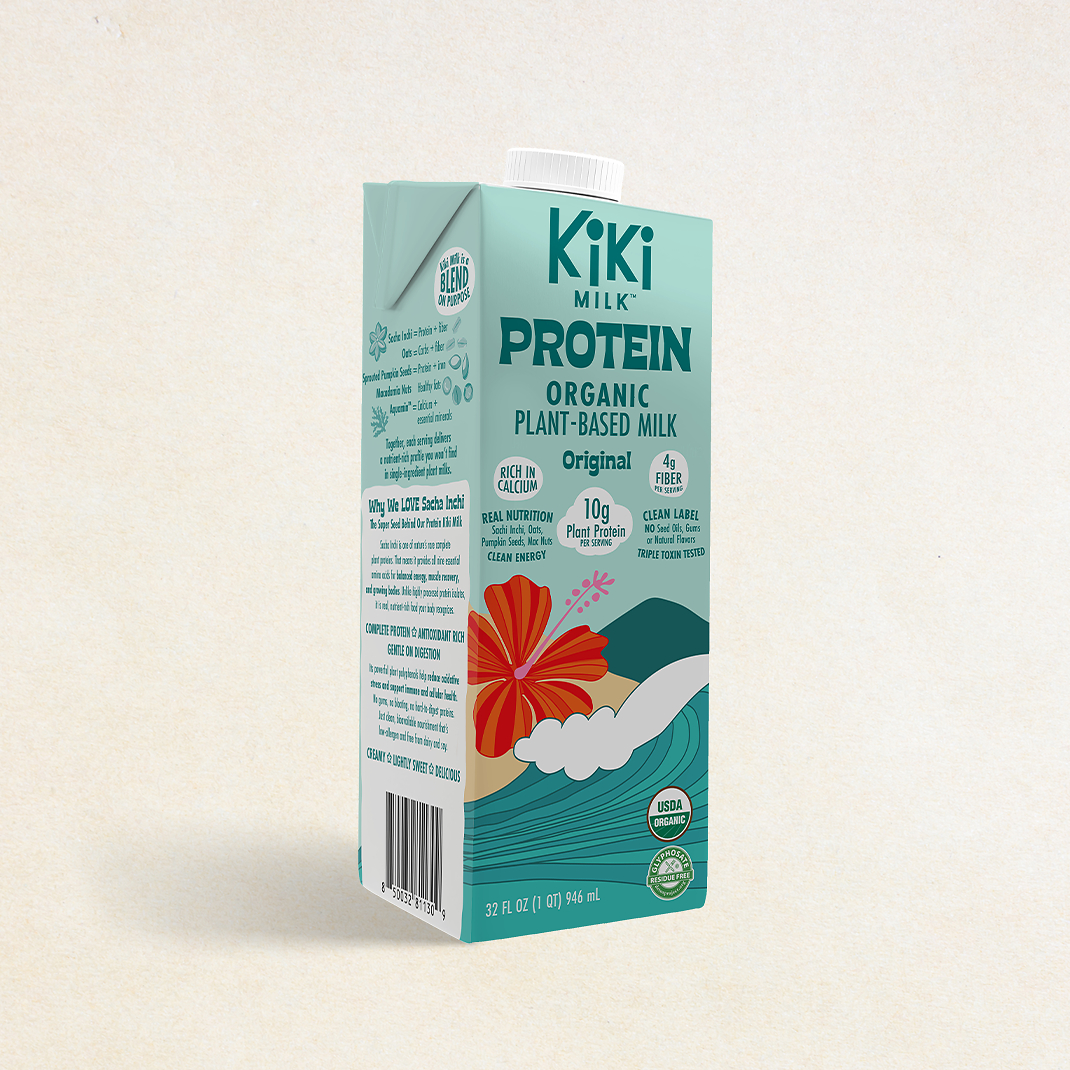
PlantBaby's Kiki Milk is moving beyond its plant-based milk foundation with the launch of Kiki Milk Protein, a USDA Organic product line built around sacha inchi — an Amazonian seed pressed into commercial use for its naturally complete amino acid profile — priced at $49.99 for a 32 oz six-pack and available now via kikimilk.com and Amazon.
The launch positions the brand at the intersection of three of foodservice and retail's most active demand signals: high-protein, high-fiber, and clean-label. Each serving delivers 10 grams of plant protein and 4 grams of fiber, with the brand explicitly avoiding protein isolate processing, gums, seed oils, and added natural flavors. The Original SKU incorporates oats for texture, and the line carries USDA Organic and Glyphosate-Residue-Free certifications.
The Market Case
The timing tracks with measurable category momentum. High-protein foods now represent a $52 billion global market, according to data cited by the brand from Towards FnB, with projections pointing toward $117 billion by 2034. Protein beverages alone account for $30 billion of that figure. Seventy-one percent of U.S. shoppers report actively trying to increase protein intake, with adoption concentrated among Millennials, Gen Z, and women — demographics that also over-index on clean-label and plant-based purchasing. Notably, 55% of parents say they want to introduce children to more plant-based protein sources but are uncertain how to do so, a gap Kiki Milk Protein is designed to address.
For foodservice buyers and retail category managers, the clean-label positioning is the operative differentiator. The conventional protein beverage segment has long relied on soy or pea protein isolates — ingredients that undergo significant processing to strip out fiber, fats, and ancillary nutrients. PlantBaby Co-Founder Alex Abelin framed the sourcing rationale directly: "We started with sacha inchi because it's naturally rich in high-quality protein, and our goal was to preserve the seed as close to its original form as possible — delivering protein in a way that works with the whole-food nutrition of the plant."
Distribution and Momentum
Kiki Milk Protein launches direct-to-consumer online, extending a distribution build that has seen the brand expand into major national chains over the past year. The online-first rollout is a common staging pattern for emerging plant-based beverage brands testing velocity before committing to retail slotting costs, and it leaves the door open for foodservice and grocery channel expansion as the SKU matures.
PlantBaby, founded in 2020 and headquartered in Kauai, Hawaii, appeared on the 2026 Inc. 5000 Fastest Growing Private Companies list — a signal that the core Kiki Milk line has achieved meaningful revenue scale ahead of this product extension. The protein launch broadens a portfolio that already spans Original, Chocolate, Unsweetened, and Mac Nut varieties.
Co-Founder Lauren Abelin made the fiber-protein pairing central to the brand's positioning: "Protein without fiber is an incomplete equation. Fiber helps slow digestion, support sustained fullness and energy, and creates a more balanced nutritional experience." That framing aligns with how better-for-you beverage brands are increasingly differentiating — not on protein grams alone, but on the nutritional context surrounding that protein.
Written by Michael Politz, Author of Guide to Restaurant Success: The Proven Process for Starting Any Restaurant Business From Scratch to Success (ISBN: 978-1-119-66896-1), Founder of Food & Beverage Magazine, the leading online magazine and resource in the industry. Designer of the Bluetooth logo and recognized in Entrepreneur Magazine's "Top 40 Under 40" for founding American Wholesale Floral, Politz is also the Co-founder of the Proof Awards and the CPG Awards and a partner in numerous consumer brands across the food and beverage sector.