
The Retail Move
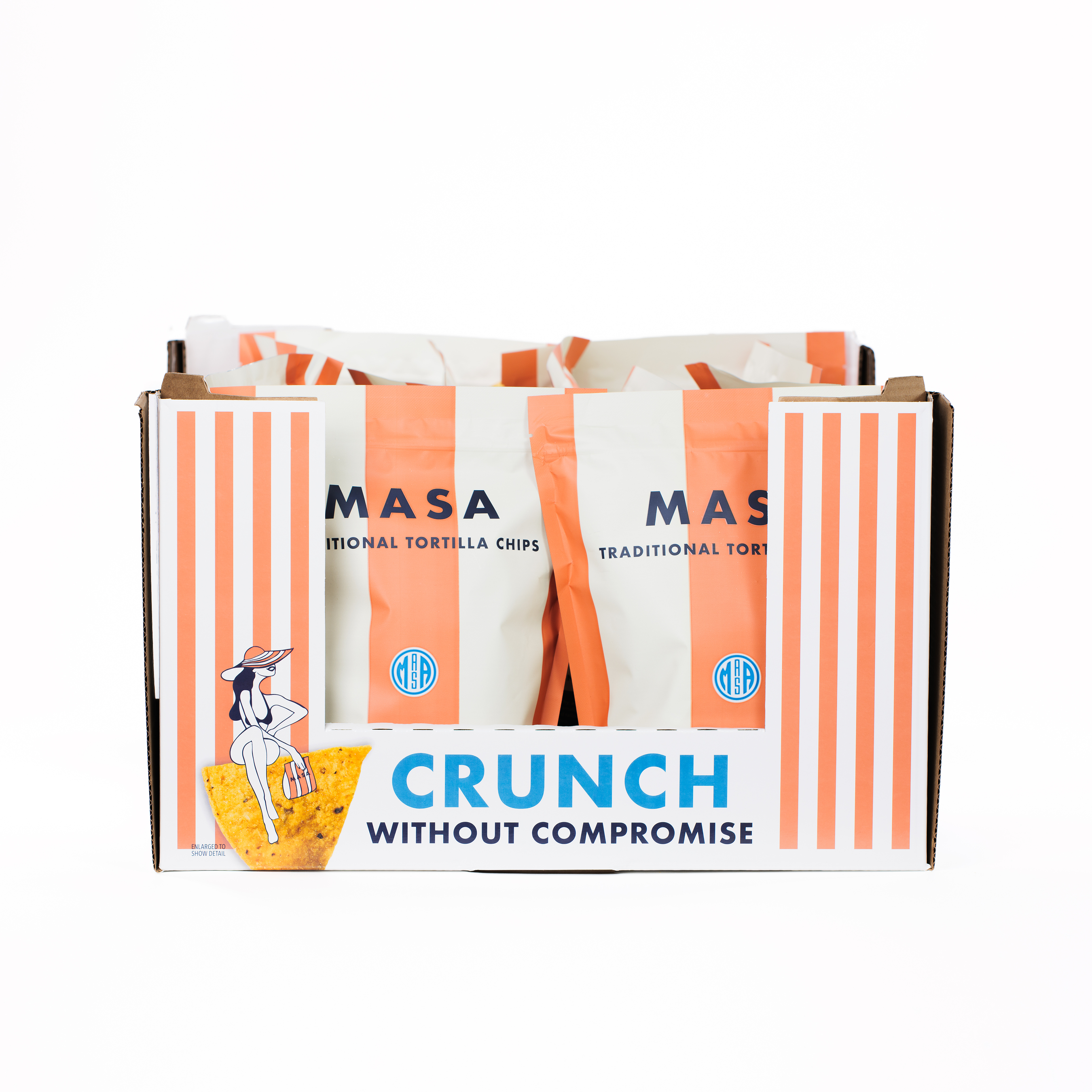
Ancient Crunch is placing its MASA tortilla chip line in 55 Costco warehouses across Washington and Oregon — the brand's first club-channel placement and a significant test of whether premium, clean-label snacks can convert at the warehouse format's characteristic bulk price points. The launch covers MASA's Original flavor in a larger-format pack sized for Costco's value-oriented membership base.
The club-channel entry comes as Ancient Crunch reports a distribution network that has grown to more than 3,000 retail doors nationwide. Current retail partners span the premium and conventional grocery spectrum: Sprouts, Erewhon, Wegmans, Whole Foods Market, Target, The Fresh Market, and HEB. The Costco expansion pushes the brand toward mainstream volume at a moment when snack-category velocity is under intense scrutiny from both buyers and investors tracking the better-for-you segment.
Volume and Velocity
Ancient Crunch says MASA now produces more than 400,000 bags per month and holds the number-one tortilla-chip velocity position at select retail partners — a metric buyers use to justify shelf resets and expanded facings. Steven Rofrano, Chief Executive Officer of Ancient Crunch, framed the Costco alignment as a values match as much as a distribution win: "Costco plays an important role in how millions of Americans shop, and their longstanding commitment to quality and value makes them a natural partner for MASA."
For foodservice-adjacent snack suppliers, Costco placement carries particular significance. Club stores function as a de facto product-discovery and trial channel, often accelerating repeat purchase in conventional grocery. A successful Pacific Northwest run could support area development into other Costco regions — a playbook established by several premium chip and snack brands before MASA.
Ingredient Story as Trade Lever
MASA's formula distinguishes it in a crowded tortilla-chip set: organic nixtamalized corn, salt, and 100% grass-fed-and-finished beef tallow — no seed oils, no artificial additives. That three-ingredient architecture is increasingly resonant with both retail buyers and foodservice operators looking for on-trend, label-friendly snack programs. The tallow-frying approach aligns with growing consumer and operator interest in animal-fat cooking methods, a trend noted across better-for-you snack segments and reflected in broader ingredient sourcing shifts in commercial kitchens.
For operators running concession, catering, or grab-and-go snack sets, MASA's club-channel expansion signals that volume supply is scaling — a practical prerequisite for any brand eyeing foodservice distribution alongside retail growth. At 400,000 bags per month and climbing, the production base is beginning to support the kind of order minimums that commercial buyers require.
Written by Michael Politz, Author of Guide to Restaurant Success: The Proven Process for Starting Any Restaurant Business From Scratch to Success (ISBN: 978-1-119-66896-1), Founder of Food & Beverage Magazine, the leading online magazine and resource in the industry. Designer of the Bluetooth logo and recognized in Entrepreneur Magazine's "Top 40 Under 40" for founding American Wholesale Floral, Politz is also the Co-founder of the Proof Awards and the CPG Awards and a partner in numerous consumer brands across the food and beverage sector.
