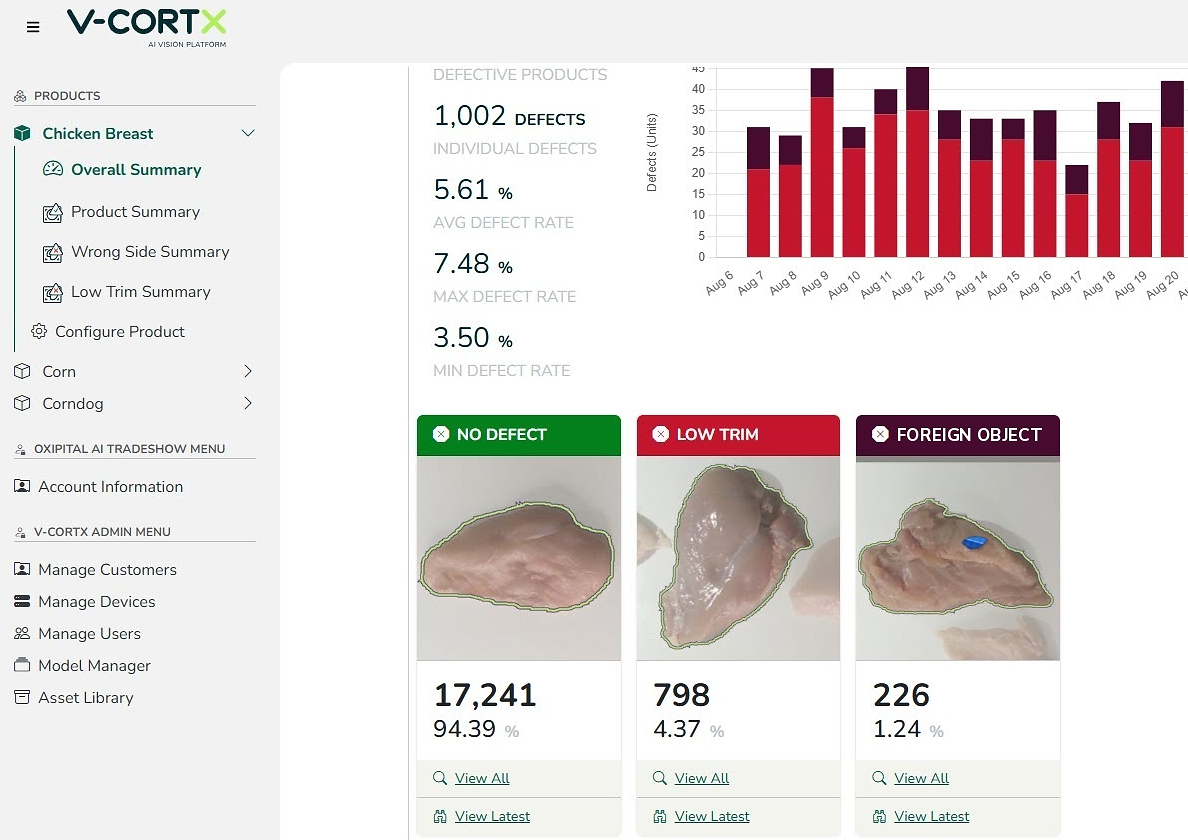
Food manufacturing operators now have a new AI-powered tool aimed at closing one of the industry's most costly quality-control gaps. Oxipital AI launched its Foreign Material Detection solution this week at Pack Expo, deploying AI vision technology on high-speed production lines to identify contaminants in real time — targeting the specific foreign materials most frequently linked to recalls and regulatory action.
The system claims detection accuracy of greater than 99%, running at full line speed without requiring a separate hardware footprint. The capability is built to operate on the company's existing OX and VX hardware platforms, which food producers already use for quality inspection and process automation, lowering the barrier to adoption for manufacturers already embedded in the Oxipital ecosystem.
Why It Matters
Foreign material contamination remains one of the leading drivers of FDA and USDA Class I and Class II recalls, carrying significant financial and reputational risk for food manufacturers and, by extension, their foodservice and retail customers. For large-scale processors supplying chain operators — where a single contamination event can trigger a system-wide menu disruption — the cost calculus around automated inspection investment has shifted sharply. Solutions that integrate into existing line infrastructure without a rip-and-replace capital commitment address a recurring objection from plant-level operations managers.
The new detection layer feeds into Oxipital's V-CORTX analytics platform, providing automated rejection response, full audit logging, and line-level reporting. That traceability component is increasingly relevant as foodservice procurement teams and chain QA departments demand upstream documentation to satisfy both internal food safety standards and evolving regulatory requirements under the FDA's Food Safety Modernization Act framework.
Deployment and Outlook
Oxipital AI states the Foreign Material Detection capability is already operating in live production environments, which distinguishes the launch from early-stage pilot announcements common in the food-tech space. Availability on installed hardware suggests a faster path to ROI for existing customers compared with greenfield deployments, a meaningful consideration given current pressure on food manufacturing capital budgets. As supply chain scrutiny from large foodservice operators intensifies — particularly around allergen control, glass, metal, and bone fragment detection — AI-driven vision systems are moving from differentiator to baseline expectation in supplier qualification conversations.
For operators and distributors tracking upstream food safety investment, this launch reflects a broader acceleration of machine-vision adoption in protein, produce, and packaged-goods processing — a trend covered in depth across the food safety and supply chain and food manufacturing technology beats at Foodservice News.
Written by Michael Politz, Author of Guide to Restaurant Success: The Proven Process for Starting Any Restaurant Business From Scratch to Success (ISBN: 978-1-119-66896-1), Founder of Food & Beverage Magazine, the leading online magazine and resource in the industry. Designer of the Bluetooth logo and recognized in Entrepreneur Magazine's "Top 40 Under 40" for founding American Wholesale Floral, Politz is also the Co-founder of the Proof Awards and the CPG Awards and a partner in numerous consumer brands across the food and beverage sector.