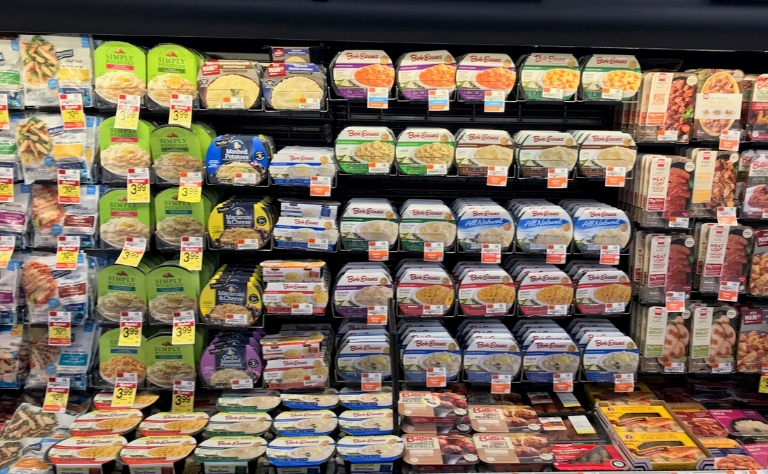
Post Holdings (NYSE: POST) reported fiscal year 2026 net sales of $8.1 billion and Adjusted EBITDA of $1.57 billion, a 2.0% gain over the prior year, while guiding fiscal 2027 Adjusted EBITDA to a range of $1.45–$1.50 billion — implying a step back from the gains logged in the year just closed. The St. Louis-based consumer packaged goods holding company operates across four segments with significant foodservice exposure through its Michael Foods and Bob Evans Farms businesses, which supply egg and refrigerated potato products to commercial kitchens and chain operators nationwide.
The Numbers
Full-year gross profit improved to $2.39 billion, or 29.4% of net sales, up from 28.7% a year earlier, as operating profit rose 5.0% to $837.6 million. Net earnings for the fiscal year ended September 30, 2026 came in at $316.6 million, down 5.4% from $334.6 million in fiscal 2025, partly reflecting a $17.5 million loss on early debt extinguishment. Adjusted diluted earnings per share reached $7.52 versus $7.16 in the prior year. The company generated $563.2 million in free cash flow after $394.4 million in capital expenditures, and finished the year with net leverage of 4.7x under its credit agreement. Post repurchased 10.3 million shares for $1.01 billion during fiscal 2026 at an average price of $98.37 per share.
The fourth quarter told a more complicated story. Net sales came in at $1.95 billion, down 13.0% year over year, though roughly $138.5 million of that decline traced directly to the pasta business divested in December 2025 and the Crystal Farms Dairy sale completed in May 2026. Adjusted EBITDA for the quarter fell 11.0% to $378.4 million from $425.4 million, with the Foodservice segment bearing the heaviest burden: segment Adjusted EBITDA dropped 24.5% to $121.6 million as the company lapped elevated egg pricing tied to the prior year's highly pathogenic avian influenza outbreak.
Segment Dynamics
The Foodservice segment — primarily egg and potato products sold into the commercial channel — posted $2.58 billion in full-year net sales, down 2.1%, yet segment Adjusted EBITDA rose 4.5% to $556.8 million as mix and pricing dynamics more than offset modest volume softness. That favorable full-year comparison is unlikely to repeat in fiscal 2027, however, as the AI-driven pricing tailwind from the prior cycle has fully normalized. Capital investment in cage-free egg facility expansion remains a priority; the company's fiscal 2027 capex guidance of $360–$400 million explicitly calls out continued foodservice egg infrastructure spending alongside nut butter manufacturing optimization in the Post Consumer Brands segment. For operators and distributors tracking egg supply and pricing, the cage-free buildout signals Post's long-term commitment to meeting procurement mandates from major quick-service and fast-casual chains.
Post Consumer Brands — the company's cereal, granola, pet food and nut butter platform — posted $4.11 billion in fiscal 2026 net sales, up 2.2%, with segment Adjusted EBITDA climbing 2.8% to $816.2 million. Those headline gains obscure underlying weakness: pet food volumes fell 12.7% in the fourth quarter, driven by distribution losses and category softness, while value cereal also surrendered shelf space. The Refrigerated Retail segment, which houses side dish, egg and sausage products for grocery retail, saw full-year net sales decline 8.3% to $873.8 million, with the Crystal Farms divestiture accounting for the bulk of the revenue reduction. Excluding that asset sale, side dish volumes grew 4.7% in Q4 on the strength of new private label offerings — a data point relevant to retailers and co-manufacturers watching the refrigerated private label category. Weetabix, the company's U.K. ready-to-eat cereal and protein shake business, was the standout performer for the year: segment profit surged 25.4% to $92.8 million and Adjusted EBITDA rose 11.6% to $138.1 million on modest branded volume growth and favorable operating leverage.
Outlook
Management guided fiscal 2027 Adjusted EBITDA to $1.45–$1.50 billion, a range that sits meaningfully below the $1.57 billion logged in fiscal 2026. The implied compression reflects the absence of avian influenza-era egg pricing across both the Foodservice and Refrigerated Retail segments, continued pet food volume pressure in Post Consumer Brands, and a higher interest expense load — net interest cost ran $424.7 million in fiscal 2026, up from $361.4 million the prior year, on higher average debt balances and a higher weighted-average rate. President and Chief Executive Officer Nicolas Catoggio and Chief Financial Officer Matthew J. Mainer are scheduled to discuss results on a November 20 conference call. The company had $396.7 million remaining under its share repurchase authorization as of mid-November.
Written by Michael Politz, Author of Guide to Restaurant Success: The Proven Process for Starting Any Restaurant Business From Scratch to Success (ISBN: 978-1-119-66896-1), Founder of Food & Beverage Magazine, the leading online magazine and resource in the industry. Designer of the Bluetooth logo and recognized in Entrepreneur Magazine's "Top 40 Under 40" for founding American Wholesale Floral, Politz is also the Co-founder of the Proof Awards and the CPG Awards and a partner in numerous consumer brands across the food and beverage sector.