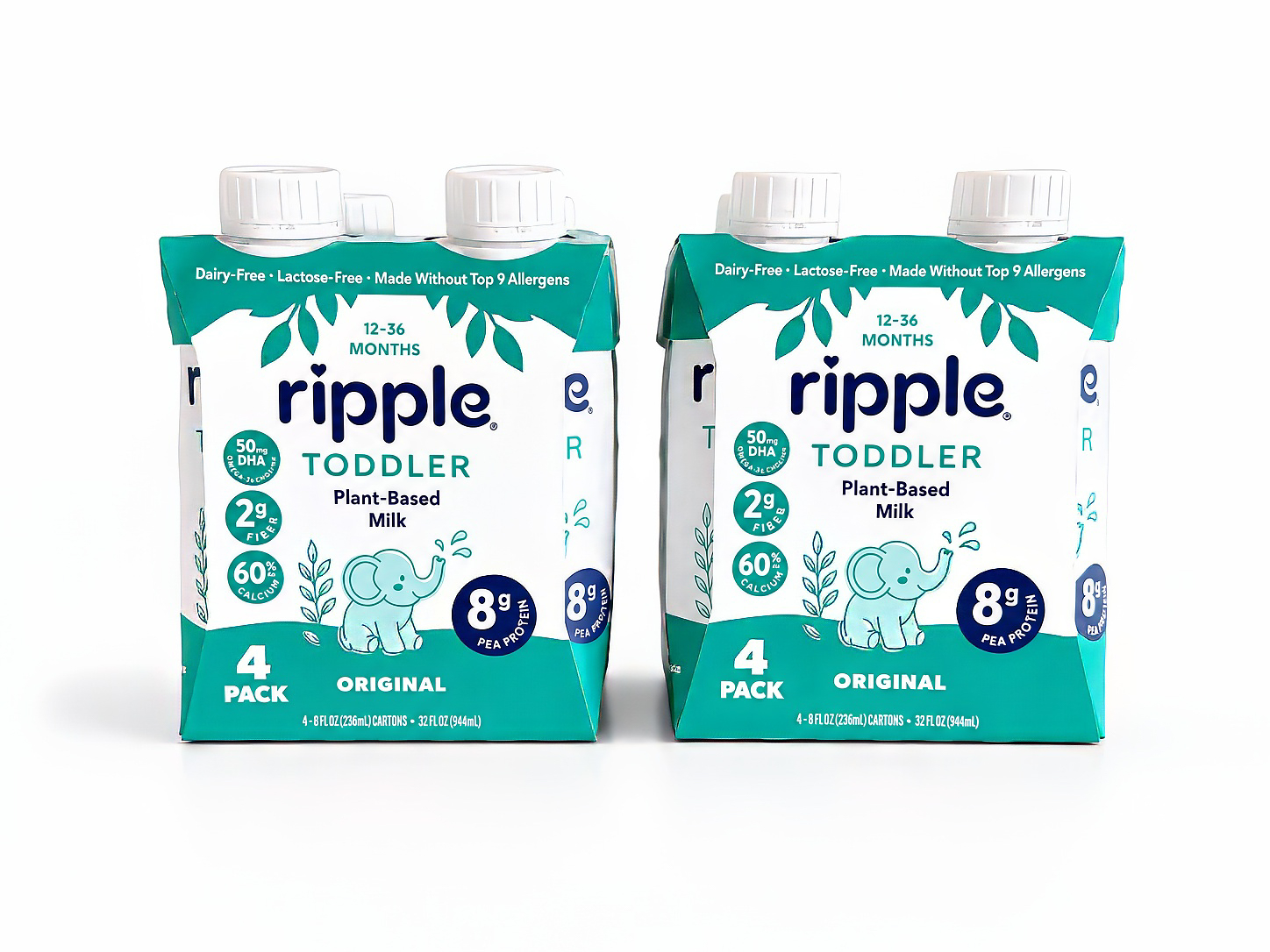
Berkeley-based Ripple Foods is moving into the toddler nutrition segment with the launch of Ripple Toddler Plant-Based Milk, a shelf-stable pea-protein carton sold exclusively through Walmart stores nationwide and Walmart.com. The product is positioned directly in the Baby Aisle — alongside established toddler-formula and transitional-milk brands — at an MSRP of $8.96 for a four-pack of 8 fl. oz. cartons.
The Product Stack
Each carton delivers 8 grams of pea protein, DHA omega-3s and choline for brain development, prebiotic fiber, and 60% of a toddler's recommended daily calcium intake. The SKU is free of the top nine allergens and carries dairy-free, soy-free, nut-free, gluten-free and 100% vegan positioning — a spec sheet that mirrors the allergen-free credentials Ripple has built across its broader refrigerated-milk and protein-shake line. Two flavor profiles are available at launch: Original and Unsweetened Original. The shelf-stable format requires no refrigeration until opened, giving it a logistics and portability advantage over chilled plant-based milks in the toddler channel.
Retail Strategy and Category Context
The Walmart exclusivity arrangement puts Ripple Toddler in front of roughly 90% of the U.S. population within 10 miles of a store, a distribution density that few emerging-brand launches can match. For Ripple, which built its retail footprint through refrigerated dairy-alternative sets, the shelf-stable Baby Aisle placement represents a meaningful channel extension — one that sits closer to infant formula than to the plant-based milk gondola where the brand typically competes.
The broader plant-based milk segment has faced volume pressure in mainstream grocery as novelty fades and private-label alternatives capture price-sensitive shoppers. Toddler nutrition, however, remains a higher-margin, need-state-driven category where parents demonstrate greater brand loyalty and lower price elasticity. Becky O'Grady, CEO of Ripple Foods, noted the existing traction of Ripple Kids as validation for the earlier-stage move: "Ripple Toddler allows us to support families even earlier, with nutrition designed for this important stage and a shelf-stable format that can go wherever their day takes them."
For foodservice and institutional operators serving early-childhood programs — daycare centers, pediatric meal programs, WIC-eligible cafeteria formats — the shelf-stable carton format is operationally relevant. No cold-chain dependency lowers the barrier for facilities without robust refrigeration infrastructure, and the allergen-free profile simplifies menu compliance across diverse populations. Operators sourcing plant-based milk alternatives for school nutrition programs should note the carton's toddler-specific nutrient profile as distinct from the standard plant-based milks that populate most K-12 contracts.
The launch also signals where pea-protein innovation is heading: away from adult performance nutrition and toward life-stage-specific formats. Plant-based beverage brands that have struggled to sustain velocity in the commodity-adjacent fluid-milk replacement space are increasingly exploring age-targeted or occasion-targeted sub-lines to justify premium price points and secure preferred shelf placement.
Written by Michael Politz, Author of Guide to Restaurant Success: The Proven Process for Starting Any Restaurant Business From Scratch to Success (ISBN: 978-1-119-66896-1), Founder of Food & Beverage Magazine, the leading online magazine and resource in the industry. Designer of the Bluetooth logo and recognized in Entrepreneur Magazine's "Top 40 Under 40" for founding American Wholesale Floral, Politz is also the Co-founder of the Proof Awards and the CPG Awards and a partner in numerous consumer brands across the food and beverage sector.