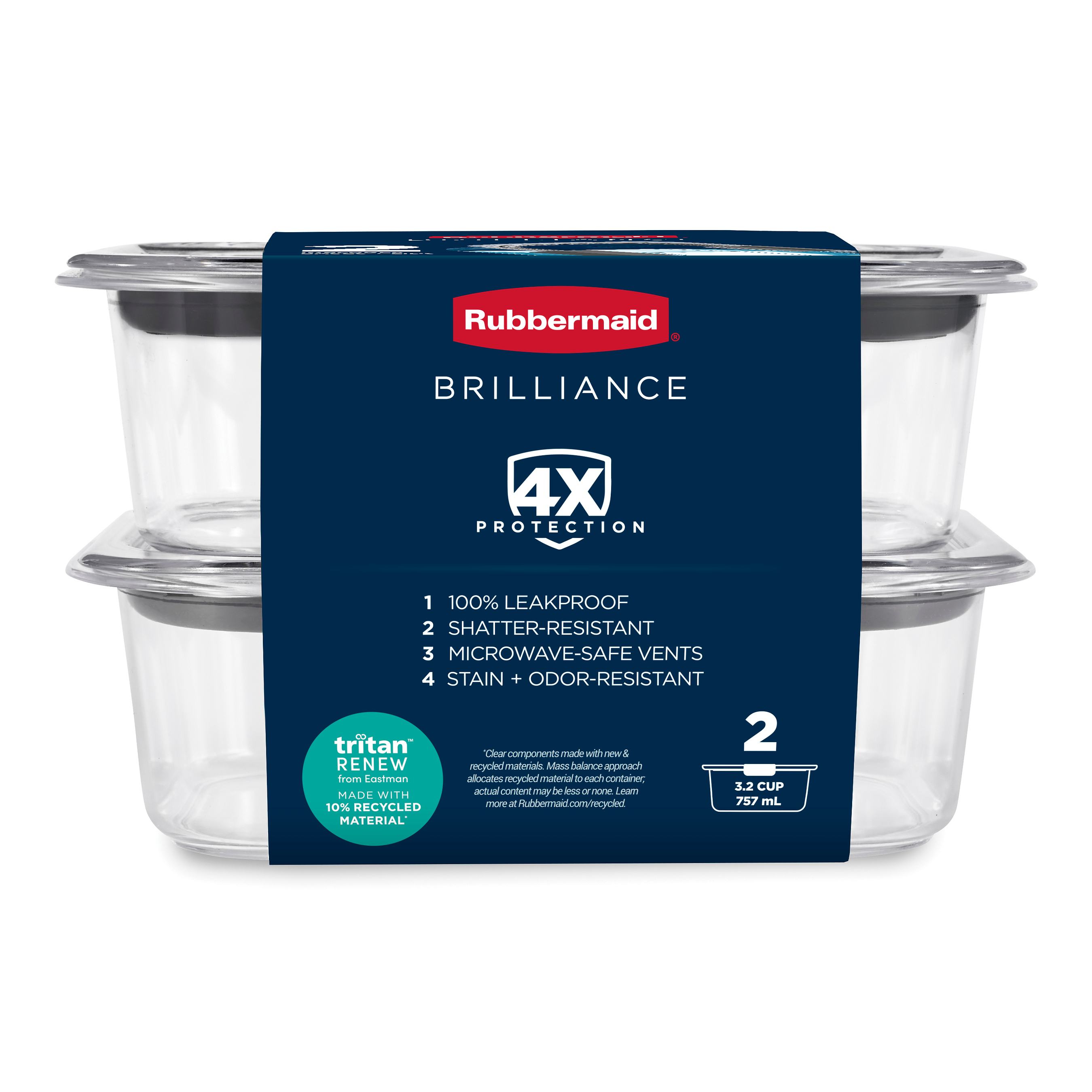
Rubbermaid's Brilliance food storage portfolio has added a line of containers incorporating Tritan Renew from Eastman, a copolyester made with certified recycled content through Eastman's advanced molecular recycling technology. The updated SKUs — rectangular and round food storage containers plus pantry canisters for dry goods — arrived at major retailers in April 2026, extending a product line that has been a staple in organized kitchen environments since its original launch with legacy Tritan in 2016.
Material & Performance Claims
The Tritan Renew formulation preserves the core performance attributes that have positioned Brilliance competitively against premium food storage tiers: stain-, odor- and shatter-resistance, along with the brand's patented leakproof, microwave-safe lid system. Eastman's technical team worked alongside Rubbermaid's product engineers to verify that the recycled-content material integrates into existing molds and meets food-contact safety standards — a critical threshold for any storage product used in both residential and light-duty commercial settings. Rubbermaid, part of Newell Brands (NASDAQ: NWL), notes the recycled content is allocated via a mass-balance methodology, meaning actual recycled material in any individual container may vary.
What It Means for Operators
For foodservice and hospitality procurement teams, the move signals that major storage-equipment brands are beginning to embed recycled-content materials into food-safe product lines without sacrificing the durability thresholds operators require. Leakproof, microwave-safe containers with documented food-contact compliance are table stakes in institutional pantry and prep environments, and Brilliance has long served that segment alongside its retail presence. The introduction of Tritan Renew positions the line to satisfy sustainability reporting requirements that increasingly appear in group purchasing organization (GPO) and national account specs — a growing consideration as operators face pressure from corporate ESG commitments and, in some jurisdictions, regulatory mandates on single-use plastics that are pushing procurement toward durable, longer-lifecycle alternatives.
Waylon Good, vice president of brand management for Rubbermaid food storage products, framed the partnership with Eastman as an ongoing platform play rather than a one-off SKU refresh, suggesting additional Brilliance formats could follow as Eastman scales its molecular recycling capacity. Eastman reported 2025 revenues of approximately $8.8 billion, and Tritan Renew is among the company's highest-profile commercial applications for its chemical recycling program, which processes hard-to-recycle plastics that conventional mechanical recycling cannot handle.
For category context, the premium food storage segment has seen steady trading-up as operators and consumers alike prioritize clear-visibility containers that allow ingredient identification without removal — a workflow efficiency in prep-kitchen settings. Competitors in the segment are similarly exploring bio-based and recycled-content polymers, making Rubbermaid's Eastman partnership a signal of where material standards in food storage are heading across both retail and foodservice channels. Coverage of sustainable packaging trends in food and beverage and kitchen equipment procurement continues to reflect this directional shift.
Written by Michael Politz, Author of Guide to Restaurant Success: The Proven Process for Starting Any Restaurant Business From Scratch to Success (ISBN: 978-1-119-66896-1), Founder of Food & Beverage Magazine, the leading online magazine and resource in the industry. Designer of the Bluetooth logo and recognized in Entrepreneur Magazine's "Top 40 Under 40" for founding American Wholesale Floral, Politz is also the Co-founder of the Proof Awards and the CPG Awards and a partner in numerous consumer brands across the food and beverage sector.