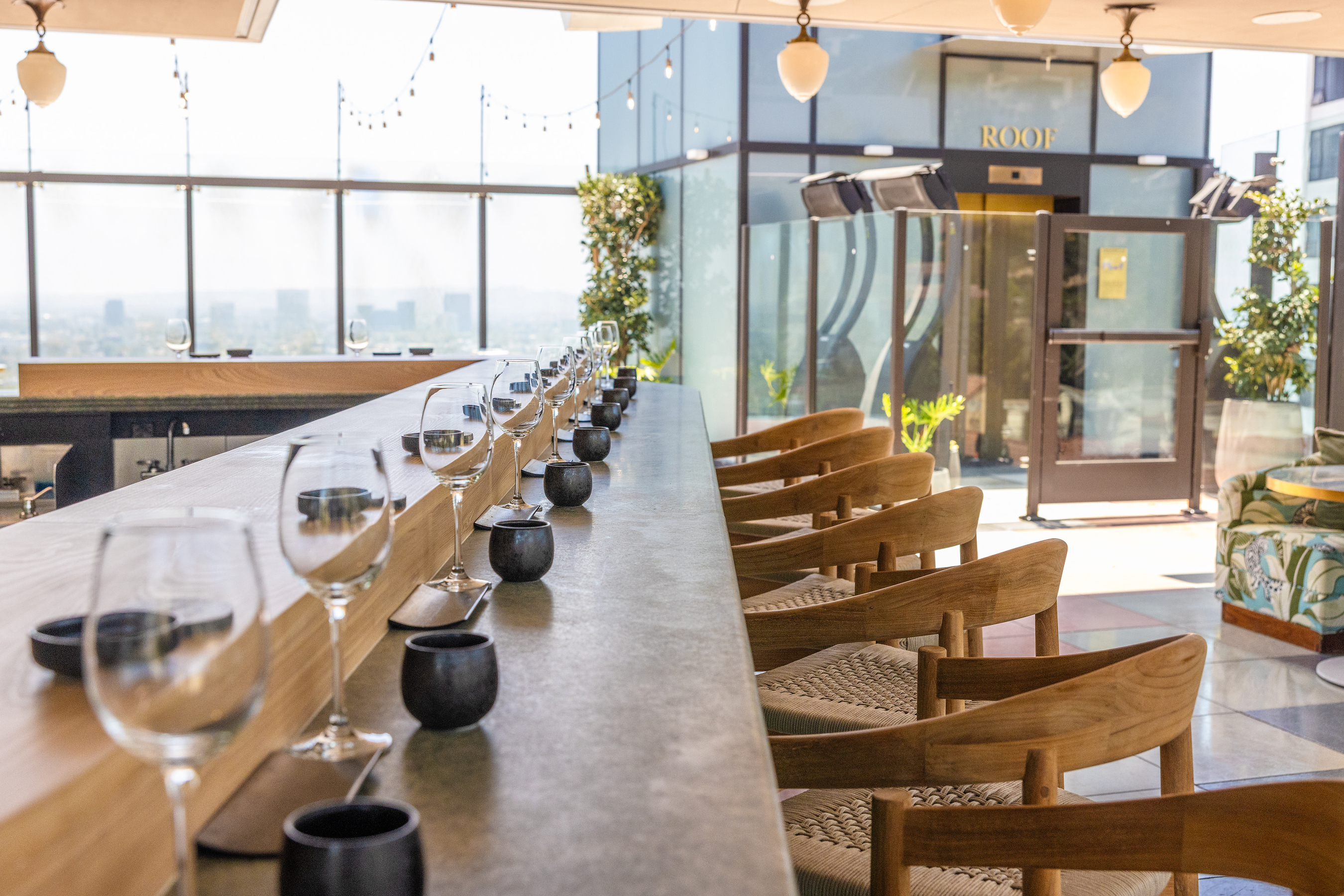
One year into its run on the Sunset Strip, The Sun Rose West Hollywood is doubling down on its culinary program with two new rooftop concepts developed in partnership with SAGA Hospitality: Yuhi, a 12-seat, 17-course omakase counter, and Oleander, a Coastal Pacific restaurant anchored by raw-bar seafood, wood-fired proteins, and bincho-grilled skewers. The dual opening positions the 149-room boutique property as a multi-concept hotel F&B operator at a moment when experiential dining is driving meaningful RevPAR contribution for independent urban hotels.
Yuhi: The Omakase Counter
Yuhi — Japanese for "evening sun" — is an intimate counter experience where each of 17 nigiri courses is sourced daily based on market availability and Chef Naomi Kubo's ingredient-driven philosophy. Kubo, whose family operated a sea urchin and seafood business across Southern California and Baja California, trained in respected Japanese kitchens nationwide, specializing in sushi, fish butchery, and omakase service. The counter's 12-seat capacity makes advance booking mandatory; reservations are live on Resy. Signature courses include Otoro dressed with pineapple, melon, chamoy, and Japanese tajin, and A5 Wagyu finished with Japanese yakiniku, toasted sesame, and grated daikon — a menu architecture that speaks directly to the premium, multi-hour tasting format increasingly popular in coastal urban markets.
Oleander: Coastal Pacific All-Day
Oleander, situated poolside on the same rooftop, casts a wider daypart net. The lunch-to-dinner concept pulls culinary reference points from across the Pacific Rim — Peruvian ceviche technique, Japanese binchotan grilling, Mexican char, and Hawaiian hospitality — into a single menu designed for sharing. Executive Chef de Cuisine Grace Dong, a Korean American chef raised in Los Angeles and previously with Soho House, leads the kitchen. Lunch leans into raw-bar starters and composed proteins — oysters with yuzu kosho mignonette, Huli Huli half chicken — while dinner shifts toward larger-format wood-fired and grilled dishes, including a 28 oz bone-in Wagyu ribeye with garlic-roasted bone marrow and Wood-Fired Puerto Nuevo Lobster. The beverage program mirrors the Coastal Pacific throughline with cocktails that reference Japanese whisky, yuzu shochu, and Latin American flavor profiles, adding a revenue layer beyond food covers that hotel F&B operators are increasingly prioritizing.
Hotel F&B as a Differentiator
The two rooftop openings build on an existing hotel F&B stack that includes Ritual, a lobby bar, and Palmier, an all-day café. Together, the four outlets give The Sun Rose West Hollywood a multi-concept hotel dining structure that competes directly with standalone independents for destination dining traffic — a strategy luxury independents are deploying to offset reliance on room revenue alone. SAGA Hospitality, whose portfolio spans both coasts and includes a Disney Storyliving Community partnership, brings a disciplined operations model to what could otherwise be a boutique hotel's weak point: scaling original F&B concepts without sacrificing culinary identity. Kris Umstattd, General Manager of The Sun Rose West Hollywood, noted that the concepts were designed to work individually and as a unified narrative tied to the property's Sunset Strip address. West Hollywood's dining density — and diner expectations — make that kind of intentional concept layering a competitive necessity rather than a luxury.
Written by Michael Politz, Author of Guide to Restaurant Success: The Proven Process for Starting Any Restaurant Business From Scratch to Success (ISBN: 978-1-119-66896-1), Founder of Food & Beverage Magazine, the leading online magazine and resource in the industry. Designer of the Bluetooth logo and recognized in Entrepreneur Magazine's "Top 40 Under 40" for founding American Wholesale Floral, Politz is also the Co-founder of the Proof Awards and the CPG Awards and a partner in numerous consumer brands across the food and beverage sector.