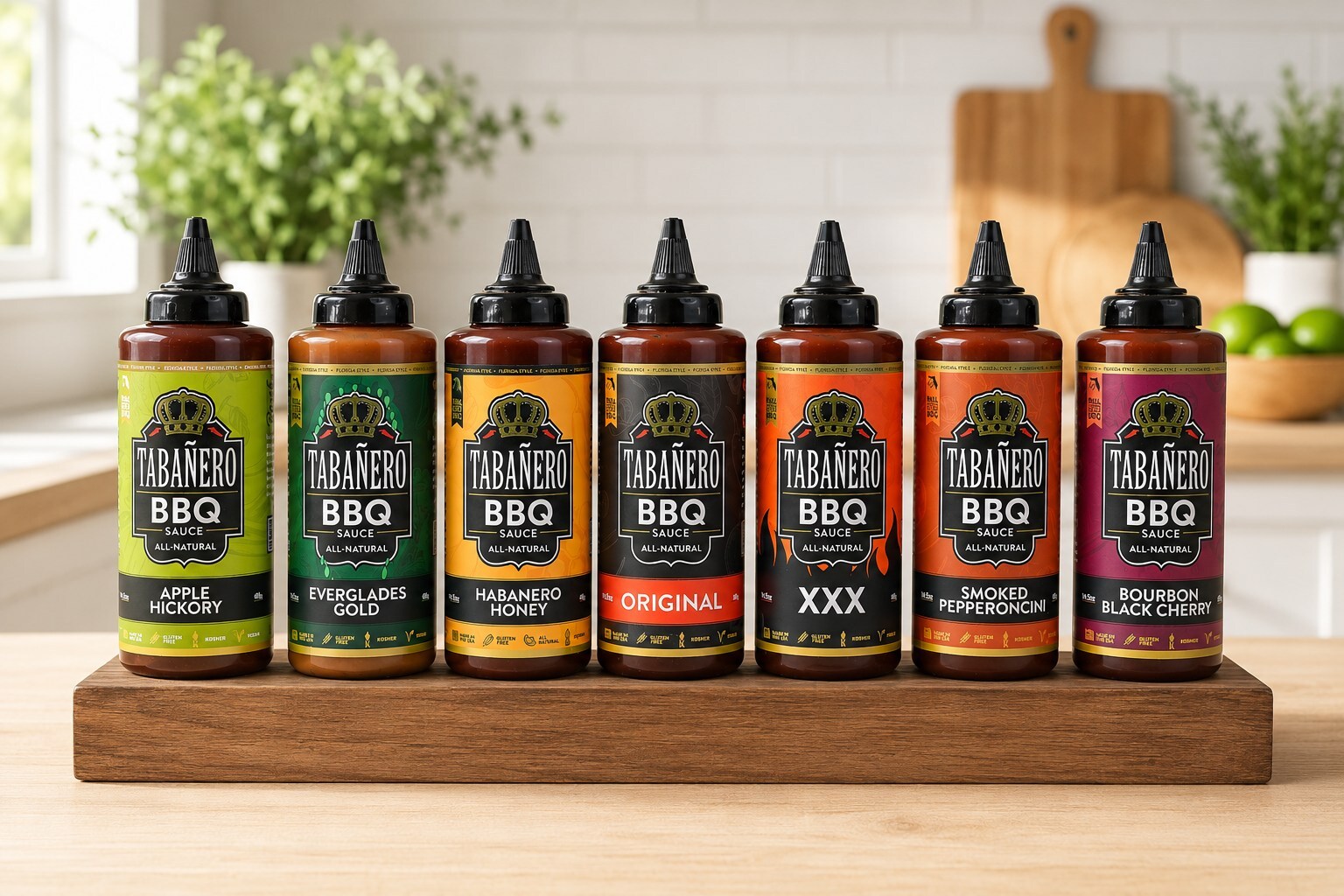
Tabañero Holdings, the Delray Beach-based condiment company behind a line of premium hot sauces, is expanding its portfolio into the barbecue sauce segment with a seven-SKU collection it says delivers approximately half the sugar and calories of leading category brands. The launch positions Tabañero as a challenger in the crowded table-sauce aisle at a moment when clean-label claims are increasingly influencing both retail buyers and foodservice procurement teams.
The new Tabañero BBQ Sauces are formulated with locally sourced Florida produce and carry no figures on AUV or distribution volumes in the initial announcement, but the brand frames the launch around a measurable nutritional advantage: roughly 50% fewer calories and sugar grams versus mainstream barbecue sauce benchmarks. Seven distinct flavor expressions span the line, each described as chef-inspired and rooted in Florida's layered culinary identity — a convergence of Southern smoke traditions, Caribbean aromatics, and Latin American heat profiles.
The clean-label barbecue segment has seen sustained momentum as chain operators from fast casual to full service look to differentiate sauce platforms without adding artificial stabilizers or high-fructose corn syrup to their ingredient decks. For foodservice buyers, sugar reduction also carries practical menu-engineering value: lower-sugar sauces caramelize differently on proteins, reducing char risk on flat-top and grill applications and extending daypart versatility from lunch barbecue LTOs into dinner and late-night builds. Tabañero's positioning mirrors moves by several independent sauce brands that have converted regional chef credibility into broadline distribution contracts. Clean-label ingredient trends have reshaped condiment specs across QSR and fast-casual procurement, with operators increasingly auditing legacy sauce vendors against updated brand standards.
Tabañero has not disclosed retail price points, suggested foodservice contract minimums, or distribution partner agreements for the new line, leaving the channel rollout strategy opaque at launch. The brand's existing hot sauce SKUs have established a presence in specialty and natural retail, providing a base of trade relationships through which the BBQ collection could gain early placement. Whether the company pursues foodservice-specific packaging formats — gallon jugs, portion cups, or pump dispensers — will determine how quickly operators can trial the line in high-volume applications. Condiment SKU proliferation remains a margin pressure point for independent operators navigating distributor minimums, making a credible nutritional story a secondary purchase driver behind price and pack size.
The brand has not announced an area development or co-packing partnership that would accelerate scale, nor has it provided AUV or velocity data from existing hot sauce SKUs as a comp benchmark. For now, the launch reads as a category extension play designed to capture share from larger incumbents on the strength of a clean label, a regional culinary narrative, and a sugar-reduction claim that is increasingly table stakes for premium condiment positioning in 2026.
Written by Michael Politz, Author of Guide to Restaurant Success: The Proven Process for Starting Any Restaurant Business From Scratch to Success (ISBN: 978-1-119-66896-1), Founder of Food & Beverage Magazine, the leading online magazine and resource in the industry. Designer of the Bluetooth logo and recognized in Entrepreneur Magazine's "Top 40 Under 40" for founding American Wholesale Floral, Politz is also the Co-founder of the Proof Awards and the CPG Awards and a partner in numerous consumer brands across the food and beverage sector.