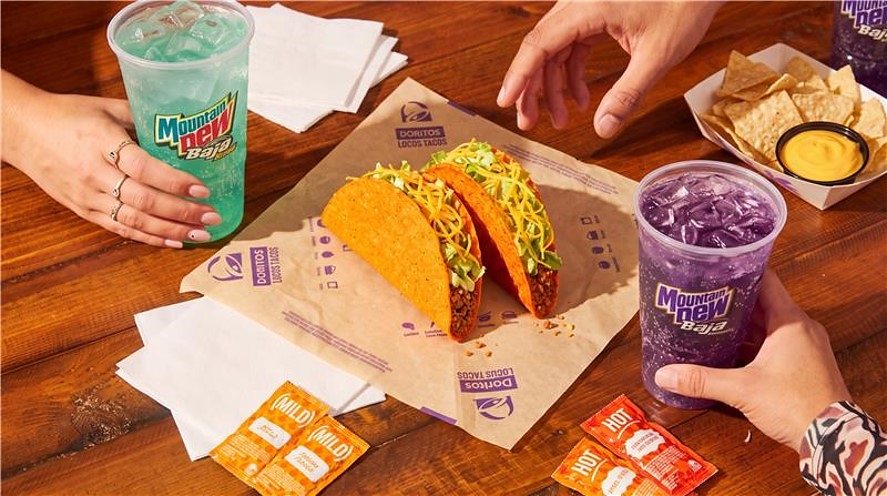
Taco Bell and PepsiCo (NASDAQ: PEP) have extended their U.S. pouring-rights agreement for 11 years, locking in PepsiCo's full beverage portfolio — including the chain-exclusive Mountain Dew Baja Blast and Baja Midnight — across participating Taco Bell, Taco Bell Cantina, and Live Más Cafe locations through 2036. The deal also establishes PepsiCo as Taco Bell's beverage partner in Canada, the United Kingdom, Ireland, and Thailand.
The Portfolio at Stake
Mountain Dew Baja Blast, born from the original partnership more than two decades ago, has since scaled into a billion-dollar brand — a rare outcome for a foodservice-exclusive beverage. The renewal keeps that exclusivity intact while positioning the Baja platform for additional LTO extensions; the companies have already cycled through Baja Midnight, a limited-time pink variant, Baja Blast Pie, and Baja Blast Gelato as proof-of-concept cultural activations. DORITOS Locos Tacos, another co-developed platform, marks its 15th anniversary in 2027 with new flavors planned — underscoring how deeply the two companies have integrated product development pipelines.
Beyond legacy SKUs, the renewed agreement targets emerging daypart and beverage-category opportunities. The companies plan to develop crafted, functional, and energy offerings aimed at Gen Z consumers, with an explicit focus on unlocking morning and afternoon occasions — historically underpenetrated dayparts for Taco Bell. A premium beverage platform called Refrescas, designed to elevate food-and-beverage pairing occasions, is already in market as an early signal of that direction.
What Operators Should Watch
"Strong partnerships have always been critical to how Taco Bell grows and evolves," said Meg Farren, Taco Bell's President, North America. "PepsiCo has been a trusted partner for over two decades, and we look forward to continuing to work hand-in-hand to drive long-term growth for the Taco Bell brand, create greater value across our system and find new ways to meet the evolving needs of our consumers."
For franchisees, the continuity of a single beverage supplier across all domestic formats removes supply-chain complexity and preserves the marketing leverage that comes from Baja Blast's cult-brand status. Pouring-rights renewals of this length — 11 years — are uncommon in the QSR segment and signal mutual confidence in Taco Bell's unit-growth trajectory. The chain's parent, Yum! Brands, has been aggressively expanding the Taco Bell footprint internationally, making the addition of Canada, the U.K., Ireland, and Thailand to PepsiCo's scope strategically aligned with that push.
Anne Fink, President of PepsiCo Global Away from Home, framed the deal as a co-creation model rather than a traditional supplier arrangement: the two companies collaborate from consumer insight through execution, a structure that has historically produced faster product-to-market timelines than either brand achieves independently. For PepsiCo's Away from Home division — which competes directly with Coca-Cola's foodservice network for anchor QSR accounts — retaining Taco Bell's U.S. volume and expanding internationally represents a meaningful defense of its large-format fountain business at a time when beverage innovation in foodservice is accelerating across crafted and functional categories.
The deal's international scope also reflects a broader QSR franchise expansion dynamic in which global operators increasingly demand consistent supplier ecosystems across markets to simplify procurement and protect brand standards.
Written by Michael Politz, Author of Guide to Restaurant Success: The Proven Process for Starting Any Restaurant Business From Scratch to Success (ISBN: 978-1-119-66896-1), Founder of Food & Beverage Magazine, the leading online magazine and resource in the industry. Designer of the Bluetooth logo and recognized in Entrepreneur Magazine's "Top 40 Under 40" for founding American Wholesale Floral, Politz is also the Co-founder of the Proof Awards and the CPG Awards and a partner in numerous consumer brands across the food and beverage sector.