
The hospitality industry has spent years talking about creating experiences, but what consumers are asking for now looks different from the immersive activations and highly produced popups that once defined the category. Increasingly, people are looking for places that make it easier to be around other people in real life, particularly in environments where conversation and connection can happen without the pressure of a formal networking event or a night built entirely around drinking. For cafés, hotels, coworking spaces, and other hospitality businesses, that shift is creating an opportunity to rethink what a physical location can provide, while opening new avenues for investors and sponsors seeking ways to connect with consumers beyond traditional advertising.
Recent consumer data supports the change. Eventbrite found that 79% of Gen Z and Millennials expect to attend more live events this year, while 74% said in-person experiences are more important to them than digital ones. Nearly nine in ten respondents said it was important for events to help them feel connected to their local community. The study also found that 58% prefer socializing when social interaction is not the primary purpose of the gathering, an important distinction for hospitality operators, investors, and brands trying to understand what younger consumers actually mean when they say they are looking for more community.
79% of Gen Z and Millennials expect to attend more live events this year, while coffee-and-running events have grown 233%.
Rather than traditional mixers or events that require attendees to walk into a room and immediately introduce themselves, consumers are increasingly gravitating toward gatherings built around something else: a class, tasting, market, competition, hobby, workshop, or shared interest. The activity provides the structure, while the social interaction develops naturally around it. Eventbrite has described this behavior as "soft socializing," and the growth of these events suggests that structured social time is becoming an increasingly meaningful part of the experience economy.
Cuss Worthy Cafe: A Model for Community-Focused Hospitality
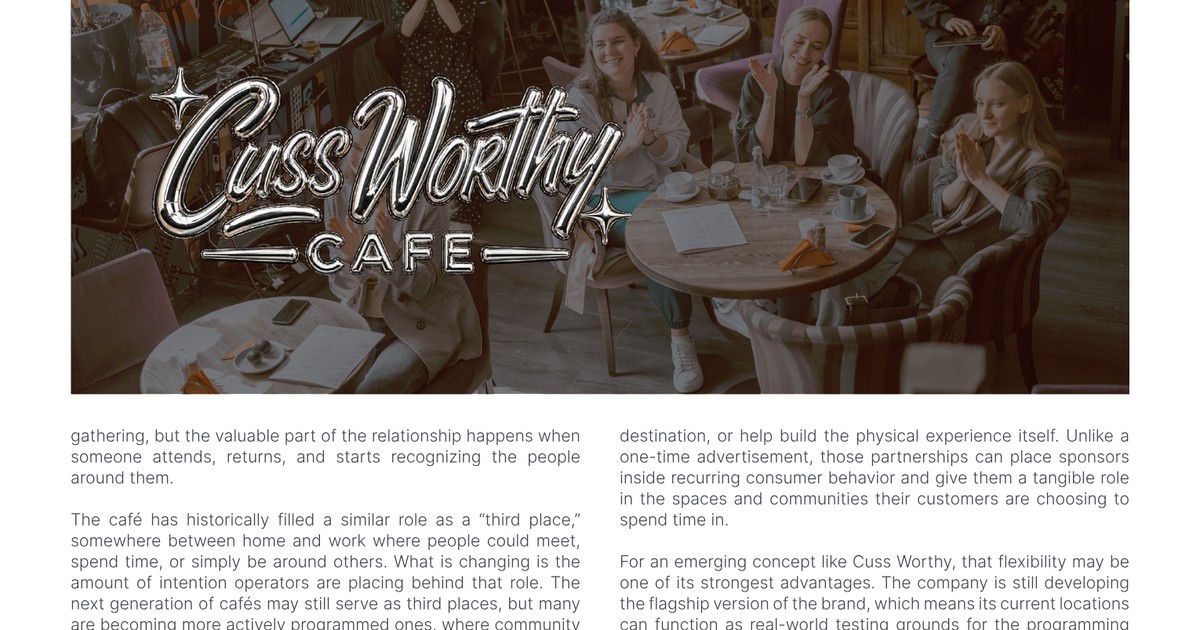
Cuss Worthy Cafe is developing its business around many of those same ideas. Currently operating from Muze Office coworking locations, the emerging café concept serves coffees, teas, and small bites while using its current footprint to develop a larger community-focused model alongside Muze. Weekly events and recurring programming are becoming part of the concept as the company works toward its flagship café, giving customers reasons to return that extend beyond the traditional coffee run.
Cuss Worthy is treating the café as more than a point of sale, building recurring reasons for people to gather, return, and become part of the community around the brand.
The relationship with a coworking environment creates a particularly useful place to develop the concept. Coworking already brings together people who may spend hours working near one another without necessarily meeting, while a café naturally creates more casual opportunities for interaction. Adding structured programming allows those two uses to overlap in a way that feels organic. A customer may first visit for coffee, later attend an event, recognize someone from a previous visit, and eventually begin treating the location as part of their normal weekly routine.
That type of behavior has become increasingly valuable as hospitality businesses compete not only with one another, but with the convenience of staying home. Consumers can work remotely, have meals delivered, shop online, and maintain relationships through their phones without entering a physical business at all. For restaurants, cafés and hospitality venues, simply having a good product is no longer always enough to create regular traffic. Giving customers a reason to physically participate in something can add another layer to the relationship between a business and its audience.
Sponsorship and Investment Opportunities
For sponsors, the same shift creates an opportunity to move beyond impressions and place brands directly inside experiences consumers have intentionally chosen to attend. Instead of interrupting an audience, experiential partnerships can become part of the reason that audience gathers in the first place. For investors, businesses capable of generating revenue across hospitality, programming, events, partnerships and recurring community traffic also create a broader model than a traditional single-purpose food and beverage operation.
The numbers around activity-driven gatherings are notable. Eventbrite reported that attendance at puzzle competitions grew 832%, coffee-and-running events rose 233%, outdoor fitness classes increased 167%, and running clubs surged 990%. Notably, 54% of attendees said they want to attend more events that combine multiple interests or communities. Those figures point toward an audience that is not necessarily searching for bigger events, but for more interesting and approachable reasons to gather.
Building Programming into Hospitality Spaces
For food and beverage operators, this creates opportunities that do not require turning every location into an entertainment venue. A café already has many of the fundamentals consumers need from a social space: comfortable surroundings, food and drinks, flexible arrival times and a relatively low barrier to entry. Programming can give that environment additional purpose, whether through a weekly gathering, small market, tasting, workshop, or other recurring event that gradually develops its own following.
Cuss Worthy is using its current operation to explore that model before its permanent flagship is fully established. Instead of waiting until a future buildout is complete to determine what its audience responds to, the company can develop programming, introduce new coffees, teas, and small bites, and see what brings people back. Updates are shared through Instagram Stories at @cussworthy, allowing customers to follow what is happening in the cafés without making the digital channel the end experience itself.
That relationship between online discovery and offline participation may become one of the more important shifts for hospitality brands over the next several years. Social media remains valuable, but for businesses centered around physical spaces, its strongest role may increasingly be getting someone off the platform and through the door. A post or story can introduce an event, menu item, or gathering, but the valuable part of the relationship happens when someone attends, returns, and starts recognizing the people around them.
The café has historically filled a similar role as a "third place," somewhere between home and work where people could meet, spend time, or simply be around others. What is changing is the amount of intention operators are placing behind that role. The next generation of cafés may still serve as third places, but many are becoming more actively programmed ones, where community is supported through a calendar of reasons to gather rather than left entirely to chance.
Cuss Worthy's longer-term plans could take that thinking beyond the café environment. The company is currently working to acquire a motel location in an Opportunity Zone, creating the potential for a broader hospitality model that combines lodging, food and beverage, events and community programming within one property. A motel also presents an opportunity to serve both visitors and locals, creating a hospitality business whose programming does not have to be limited to overnight guests.