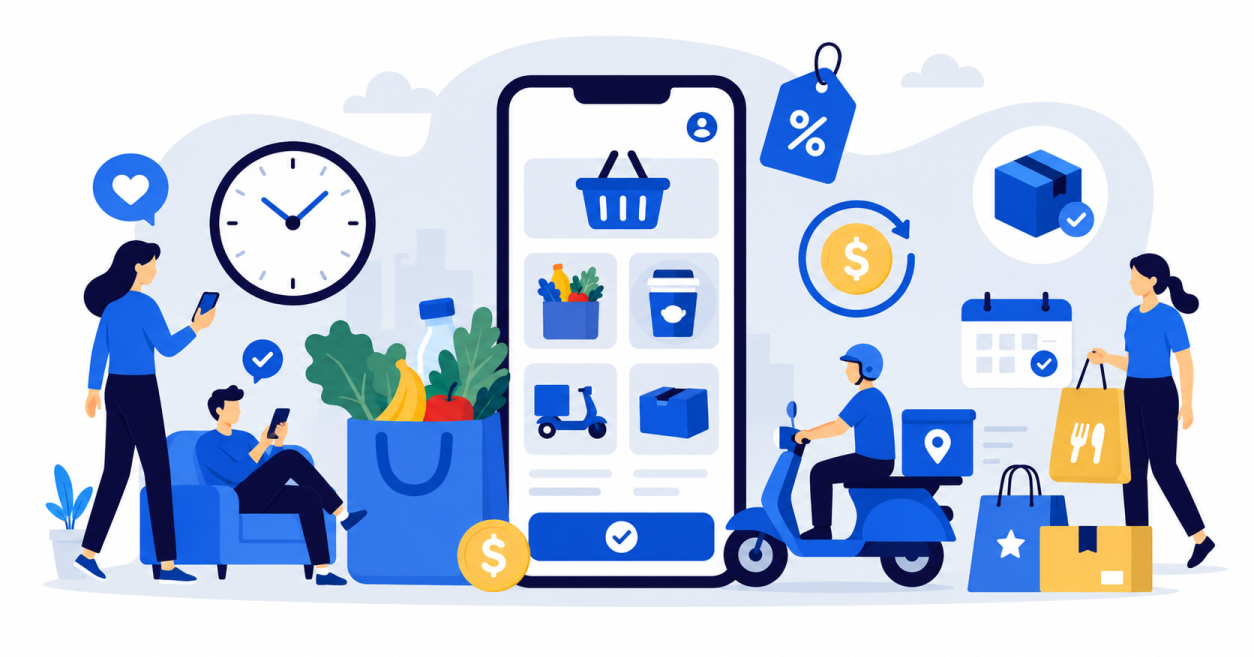
Near-universal adoption of food delivery has not eliminated consumer price resistance — it has simply relocated it. A FinanceBuzz survey of 2,000 U.S. adults, conducted in partnership with Bank of America in August 2026, finds that 97% of respondents used at least one convenience service — food delivery, takeout, grocery delivery, or errand apps — in the preceding month. More than half, 52%, say their convenience spending has grown over the last five years.
The Numbers
The data draws a clear picture of a high-adoption, fee-sensitive consumer base. Gen Z respondents logged an average of 4.3 food delivery orders per month — nearly three times the 1.5 reported by Baby Boomers. Despite that volume, 78% of Gen Z consumers said they had abandoned a delivery order after seeing the final total with fees, compared with 41% of Boomers and 68% of the overall sample. The average American reaches a tipping point at $9.49 in delivery fees before opting to pick up the order instead, though the most frequently cited threshold was just $5. Meanwhile, 85% of respondents pay for at least one convenience membership, averaging $22 per month — or $264 annually — a cost that often goes unexamined against actual usage.
Fee Sensitivity in Focus
For foodservice operators and delivery platform partners, the fee-abandonment figure carries direct unit-economics implications. High cart-abandonment rates compress effective order conversion and drive down the revenue-per-session metric that third-party platforms use to justify commission structures. The finding that consumers self-report a $9.49 fee ceiling — while simultaneously carrying $264 in annual membership costs — suggests operators face a paradox: subscribers tolerate the fixed cost of membership but balk sharply at variable per-order fees at checkout. That behavioral gap puts pressure on platforms to bundle or obscure per-order fees within membership tiers, a dynamic already visible in the subscription and loyalty strategies of major aggregators.
The time-valuation data adds context to why consumers continue spending despite sticker shock. Americans surveyed said they value an hour of free time at $87 on average — more than double the $37.62 average hourly wage reported by the Bureau of Labor Statistics. "Some people are paying for the value of the delivery, but many are paying not to think about it at all," said Melinda Sineriz, Managing Editor at FinanceBuzz. "This isn't just frivolous spending; Americans value their time, and they're willing to buy some of it back."
What It Means for Operators
The generational usage gap reinforces a strategic priority already well-documented in the off-premise channel: catering to younger, high-frequency delivery users requires a different margin calculus than serving infrequent Boomer customers. Gen Z's higher guilt and embarrassment around convenience spending — despite being the heaviest users — could signal latent churn risk if economic conditions tighten. Operators with robust owned digital channels and loyalty programs are better positioned to capture those orders at lower net commission cost. The 22% of respondents who tipped nothing on a delivery order because of perceived high fees or meal cost also points to downstream satisfaction and driver-retention dynamics that affect service reliability at the unit level.
Written by Michael Politz, Author of Guide to Restaurant Success: The Proven Process for Starting Any Restaurant Business From Scratch to Success (ISBN: 978-1-119-66896-1), Founder of Food & Beverage Magazine, the leading online magazine and resource in the industry. Designer of the Bluetooth logo and recognized in Entrepreneur Magazine's "Top 40 Under 40" for founding American Wholesale Floral, Politz is also the Co-founder of the Proof Awards and the CPG Awards and a partner in numerous consumer brands across the food and beverage sector.