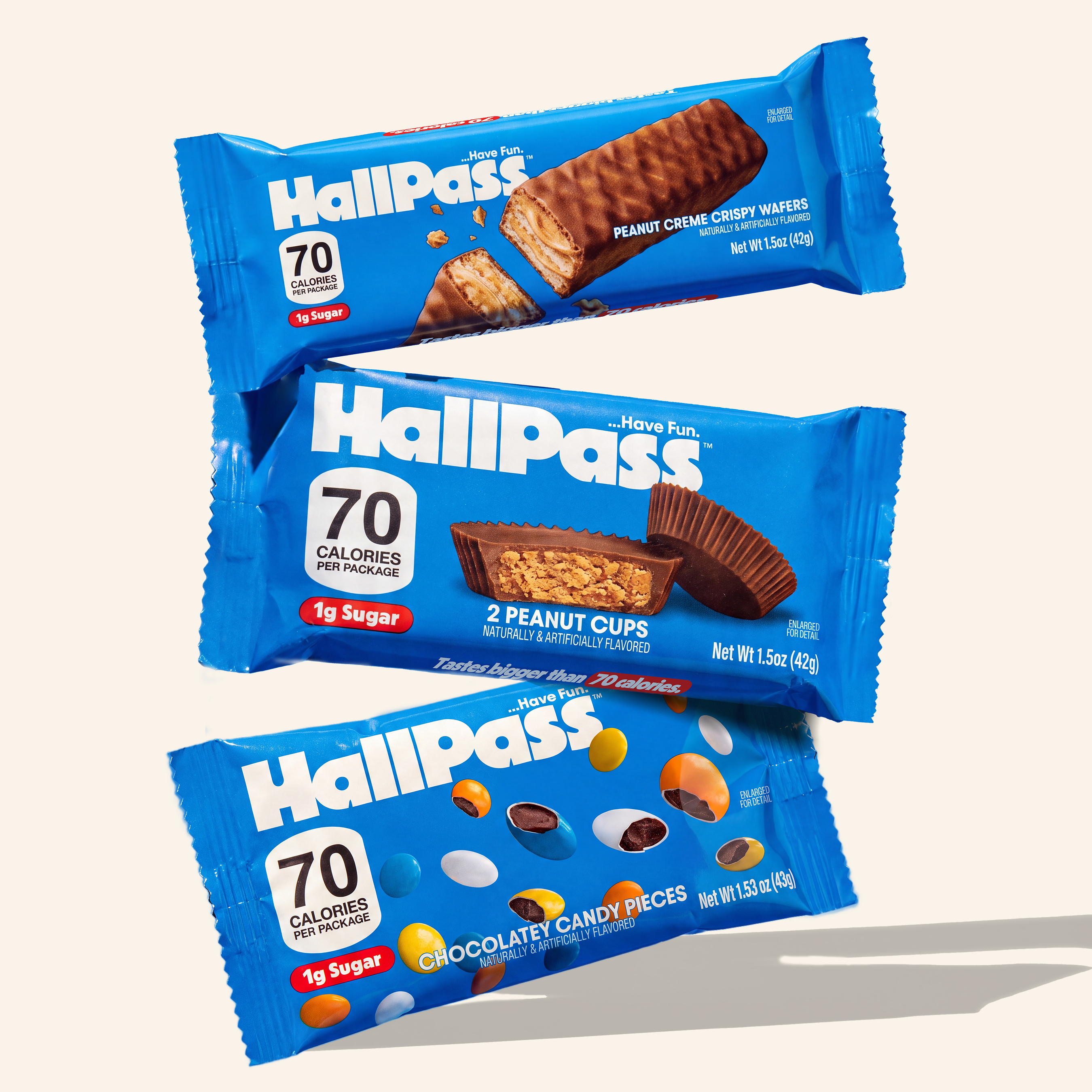
Medici Brands' newest confectionery label, HallPass, landed in Walmart stores nationwide and on Walmart.com on August 30, 2026, marking one of the more direct bids to replicate the diet-soda playbook inside the candy aisle. The launch covers three SKUs — Peanut Cups, Peanut Creme Crispy Wafers, and Chocolatey Candy Pieces — each delivering 70 calories and 1 gram of sugar per serving.
The Product Proposition
The nutritional profile is only half the pitch. Co-founder Michael Tierney framed the pricing strategy as equally disruptive: better-for-you confectionery has historically carried a significant premium over national brand equivalents, a dynamic HallPass is positioning itself to undercut. "You don't pay more for Coke Zero than classic Coke, but somehow all low sugar and low calorie candies charge a multiple of the national brands," Tierney said. "That needed to change." The brand's stated ambition is to become "the Coke Zero of candy" — mainstream price, reformulated nutrition.
Rahal is best known as co-founder of RXBar, the protein bar brand sold to Kellogg's in 2017 for $600 million, giving HallPass credible better-for-you CPG pedigree. Medici Brands, the parent entity, also houses David Protein, signaling a portfolio strategy built around macro-friendly reformulations of legacy snack categories.
Retail and Foodservice Implications
For foodservice and noncommercial operators tracking snack and impulse categories — particularly convenience-adjacent channels, college and university dining, and vending — the Walmart launch establishes immediate national visibility. A mass-retail entry at price parity with conventional candy reduces the friction that has historically slowed better-for-you SKU adoption in price-sensitive environments. If HallPass achieves the turn rates needed to hold Walmart shelf space, it creates a proven velocity story that could accelerate conversations with foodservice distributors and contract operators.
The better-for-you confectionery segment has grown steadily as consumers apply the same scrutiny to sweets that reshaped protein snacks and functional beverages over the past decade. The comparison to diet cola is instructive: Diet Coke and Coke Zero collectively account for a substantial share of total CSD volume, demonstrating that reformulated versions of iconic categories can reach mainstream scale without margin sacrifice — provided the sensory experience holds. HallPass is betting the candy aisle is due for the same bifurcation between traditional and reformulated tiers. For operators managing snack and beverage programs, the emergence of credible low-calorie candy at non-premium price points expands the better-for-you assortment without requiring a trade-up ask at point of sale.
No retail door count, AUV targets, or distribution terms were disclosed at launch. The brand is available concurrently at HallPassCandy.com, suggesting a direct-to-consumer data layer alongside the mass-retail push — a structure increasingly common among emerging CPG brands seeking consumer insight to support retail and channel expansion negotiations.
Written by Michael Politz, Author of Guide to Restaurant Success: The Proven Process for Starting Any Restaurant Business From Scratch to Success (ISBN: 978-1-119-66896-1), Founder of Food & Beverage Magazine, the leading online magazine and resource in the industry. Designer of the Bluetooth logo and recognized in Entrepreneur Magazine's "Top 40 Under 40" for founding American Wholesale Floral, Politz is also the Co-founder of the Proof Awards and the CPG Awards and a partner in numerous consumer brands across the food and beverage sector.