Here's a conversation that plays out roughly once a month with independent operators who are otherwise doing everything right.
They have great food. Strong reviews. A social presence with real engagement. A team that shows up. And covers that are… inconsistent. Some weeks are packed. Others are quiet without any obvious reason. Marketing feels like a lottery — sometimes a post pops, sometimes it doesn't, and there's no way to force a good Tuesday when they need one.
The diagnosis is almost always the same: they don't own their audience. Every guest they've served is behind a wall — a social algorithm, a review platform, a delivery app — that they don't control and that can change the terms without warning.
We spent the last four installments building the attention side of the business. This piece is about the other half of the equation: turning rented attention into owned attention. Because in an attention economy, the operators building enterprise value — the kind that shows up in a sale multiple, not just a P&L — are the ones with an audience they can reach on their own schedule, without paying anyone else for permission.
The Data: Owned Channels Are the Highest-ROI Channels in the Industry
The numbers on email and SMS aren't just favorable. They're in a different category from every other marketing channel available to restaurants.
- Email delivers $36–$44 in revenue for every $1 spent, on average, across the restaurant industry (Restroworks, 2025; Evok Advertising, 2026; Litmus State of Email 2025 via Evok).
- SMS delivers $71 per $1 spent, with 98% open rates and 81% of consumers checking texts within 5 minutes (Rezku, 2026).
- Automated email and SMS campaigns deliver $15–$25 per $1 spent — the single highest ROI of any restaurant marketing channel — with a median payback period of 14 days (BentoBox 2025 Restaurant Marketing ROI Study via US Tech Automations).
- Automated emails accounted for 2% of total sends but drove 30% of revenue in Omnisend's 2026 benchmark (Akron Beacon Journal, 2026).
- Loyalty members make 22% more restaurant visits per year than non-members and now account for 39% of total restaurant visits, according to Circana's 2025 analysis of receipt data from four of the largest U.S. restaurant loyalty programs (Akron Beacon Journal, 2026).
- 83% of diners are willing to sign up for restaurant marketing programs — but they expect VIP treatment, not just a discount (SevenRooms 2025 US Data Report).
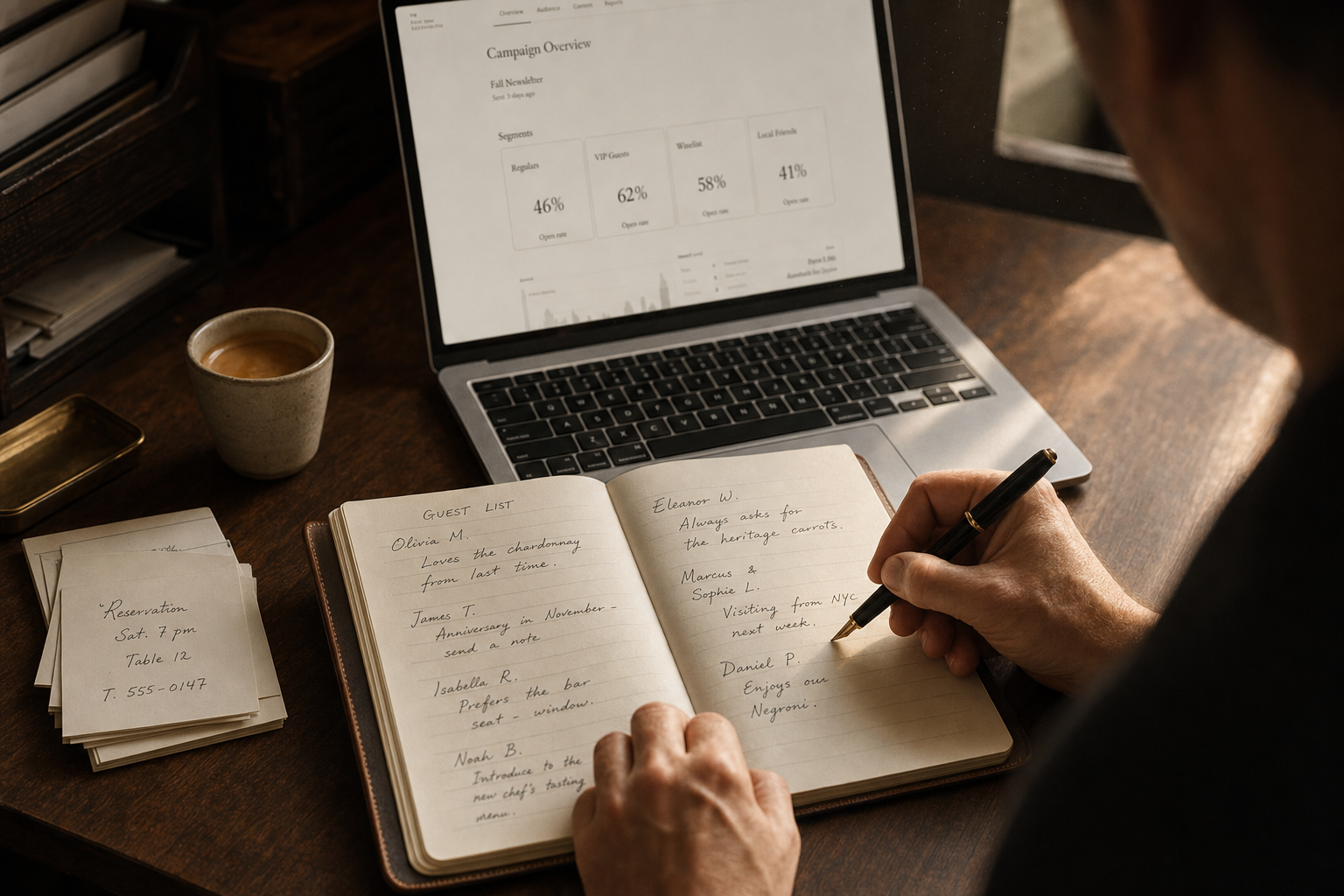
- Segmented email campaigns deliver 14.31% higher opens and 100.95% higher clicks than non-segmented sends (Mailchimp analysis via Akron Beacon Journal, 2026).
Translate that to an 80-seat full-service restaurant: a well-run automated email and SMS stack, according to BentoBox's modeling, generates $227,000–$317,000 in attributable annual revenue against a platform cost of $3,600–$9,200 (US Tech Automations).
The rented channels — Instagram, TikTok, Yelp, Google — cost you every quarter and change the deal every year. The owned channels compound.
Why "We Have an Email List" Isn't Enough
Most independent restaurants have an email list. Most of those lists are dead weight. Three symptoms tell you if yours is one of them:
- The list is a single, unsegmented blob — birthdays, first-timers, weekly regulars, and lapsed six-month guests all get the same email.
- Sends happen once a month or less, usually a "here's our new menu" blast that gets 12% open rates.
- There's no automation — nothing triggers based on behavior, occasion, or lifecycle stage.
A list like that is technically an asset and functionally a burden. The operators building real owned-audience value have crossed four thresholds:
1. Every guest is captured — reservations, POS, WiFi login, loyalty signup. 2. Every guest is segmented — by visit frequency, spend band, daypart, and lifecycle stage. 3. Every segment has automated flows running against it — welcome, birthday, win-back, VIP, event. 4. Every send is measured through to revenue via UTM, reservation-platform matching, and POS email matching.
Those four moves are what turn a list into an audience.
The Owned Audience Ladder
Here's the ladder the top-performing independents use to move guests from anonymous visits to identified super-fans. Six rungs:
Rung 1 — Anonymous Visit. The guest ate, paid, left. You have no idea who they were. This is where most restaurants live for the majority of their guests. Every anonymous visit is a broken flywheel.
Rung 2 — First-Party Capture. The guest provided an email or phone number — through reservation, WiFi, online order, or a QR-code opt-in. Now they exist in your CRM. This is the single most important operational upgrade most restaurants can make.
Rung 3 — First Automated Touch. The welcome series fires. Two or three emails or texts introducing the restaurant, the story, the signature dishes, and one no-strings invitation back. Welcome flows alone can generate $20,000–$31,000/year for an 80-seat operator (BentoBox modeling via US Tech Automations).
Rung 4 — Second Visit Confirmed. The guest returned. Their frequency, spend, and daypart preferences are now tagged. They're segmented. Marketing gets personal from here.
Rung 5 — Loyalty Member. They opted into the program. They earn, they redeem, they identify themselves at every visit. Loyalty members visit 22% more often and, per Klaviyo's 2025 research, are 38% more likely than the general population to plan to increase their restaurant spending over the next six months (Klaviyo, 2025).
Rung 6 — VIP / Super-Fan. Top 5% of the list by visit or spend. Named. Recognized on arrival. Reached out to personally by the owner or GM for openings, previews, and small-batch experiences. This is the tier that will save your worst quarters. Every restaurant that has survived a downturn had a rung-6 audience they could pick up the phone with.
The operators winning at owned attention are the ones who have designed explicit, automated mechanics to move guests up the ladder — not the ones hoping a great meal is enough.
The Nine Automated Flows Every Restaurant Should Be Running
Automation is not a "phase two" project. It's the entire operating model. Here are the nine flows every restaurant of any size should have running — and roughly what each is worth, based on BentoBox's 2025 modeling for an 80-seat full-service operator (US Tech Automations, 2026):
1. Welcome series (email + SMS) — first-time visitor onboarding. ~$20K–$31K annual. 2. Birthday and anniversary — the single highest-ROI email a restaurant will ever send. ~$30K–$45K. 3. Win-back sequence — triggered at 60 days of no visit. ~$7K–$11K. 4. Slow-night SMS fill — same-day text to a curated segment when Tuesday is soft. ~$46K–$54K. 5. Post-visit feedback — automated NSAT survey + review-site steering for high scorers. ~$9K–$16K. 6. VIP recognition — top 5% of guests, hand-signed cadence. ~$31K–$47K. 7. Event promotion — private dinners, holidays, chef series. ~$67K–$90K. 8. Loyalty engagement — points reminders, tier upgrades, expiration nudges. ~$15K–$22K. 9. Menu launch / seasonal — targeted by past order history. (Variable, often the biggest single lift.)
Combined attributable revenue in the moderate scenario: ~$316,000/year. Combined platform cost: ~$7,200/year. Payback period on the entire stack: roughly 8 days (US Tech Automations).
The reason most restaurants aren't running these isn't that they don't work. It's that they've never been assembled into a checklist. Now they have.
The "VIP by Default" Model
Here's the shift underneath the numbers. The old loyalty model was transactional — spend $10, get $1 back. That model still works, sort of, for chains with heavy volume and thin margins. But it doesn't work for independents, because independents don't win on discounts. They win on recognition.
The new operating model — the one 83% of diners are actually asking for (SevenRooms, 2025) — is VIP by default. The mental model:
- Every subscriber is treated like a regular from the first email.
- Every regular is treated like a VIP from the first repeat visit.
- Every VIP is treated like a partner — early access, small-batch previews, chef's-table pours, the seat at the counter with the view of the pass.
The operators using this model report loyalty members spending more per order ($100+) and dining more frequently (1x/week) — a double compounding effect on lifetime value (Klaviyo, 2025). Discounts get you a redemption. Recognition gets you a decade.
Why This Also Sells the Business
There's a final reason owned attention matters that most operators don't think about until it's too late: it changes what your restaurant is worth if you sell.
A restaurant valued on EBITDA alone is worth some multiple of its cash flow — typically 2–4x for independent full-service. A restaurant that can hand a buyer a segmented, engaged, first-party audience of 15,000–50,000 opted-in guests with documented conversion history is a fundamentally different asset. Buyers will pay a premium for a customer base they can market to on day one, and they will discount aggressively for a business whose "audience" lives on someone else's platform.
If you never plan to sell — build the list anyway. If you ever might — the list is the single asset most likely to move your multiple.
The Bottom Line
Social platforms rent you attention. Owned channels earn it. The operators quietly building the next decade of restaurant enterprise value aren't the ones with the biggest followings. They're the ones with the deepest, most segmented, most automated first-party audiences — and the discipline to treat every subscriber like a regular and every regular like a VIP.
Every anonymous visit is a broken flywheel. Every captured email is the first rung on the ladder. Every automated flow is a compounding asset. Every segmented send is a proof point for the next buyer, banker, or partner who asks what the business is actually worth.
Own the audience. Everything else is rented.
Coming next — Part 6: The Attention P&L. How the smartest operators are measuring attention like they measure food cost — and why the four metrics they track weekly are leading indicators of everything else.
Want the 9-flow Owned Attention Playbook — including the segmentation rules and copy templates? Subscribe to Food & Beverage Magazine for the download. Meet us at the NRA Show for the "Owned Audience" workshop with operators running the full stack.