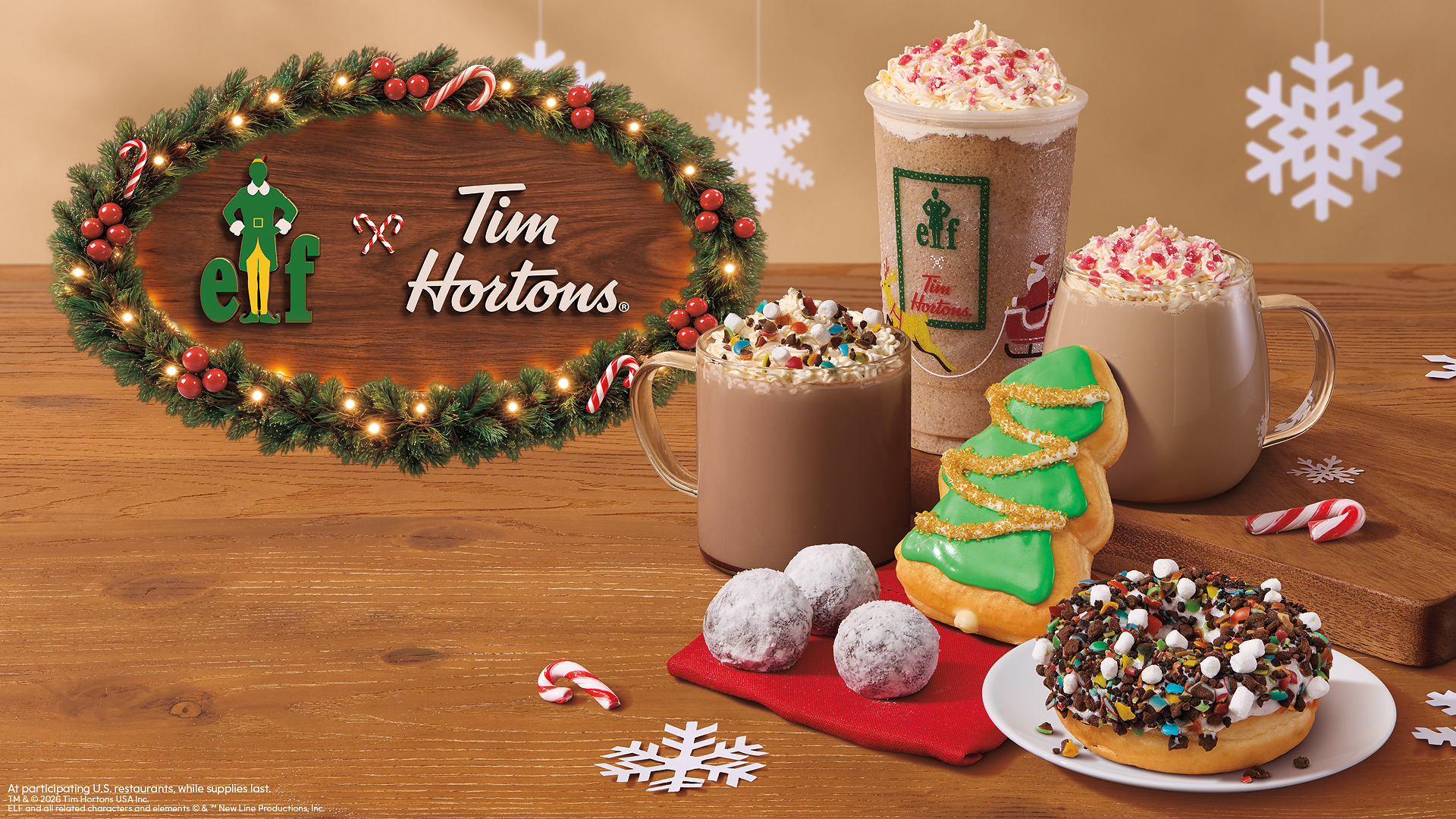
Tim Hortons](https://www.timhortons.com/) is leaning into licensed IP to drive holiday traffic, launching a six-item ELF-themed limited-time menu at participating U.S. restaurants in partnership with Warner Bros. Consumer Products. The campaign, tied to New Line Cinema's perennially re-watched holiday film, spans both food and beverage dayparts and arrives alongside limited-edition ELF x Tim Hortons co-branded packaging.
The LTO Lineup
The new menu breaks into two categories. On the food side, Tim Hortons is introducing three items: the ELF Chaos Donut, a yeast ring finished with vanilla icing, crushed candy, chocolate, and mini marshmallows; ELF Snowball Timbits, chocolate cake donut holes dusted in powdered sugar; and the Holiday Cheer Donut, a tree-shaped yeast donut with green vanilla icing and a gold sugar garland. On the beverage side, the chain is adding a Candy Cane Forest ELF Latte (available hot or iced) built on espresso and steamed milk with peppermint-flavored syrup and peppermint-piece topping; a Candy Cane Forest ELF Iced Capp using the brand's frozen blended coffee base with the same peppermint treatment; and an ELF Hot Chocolate topped with spaghetti-shaped whipped topping — a nod to the film's most recognizable scene — plus chocolate cookie crumble and crushed candy pieces.
Licensing Strategy in QSR
For a chain still building U.S. brand recognition against entrenched QSR coffee competitors, a studio IP tie-in offers an efficient path to cultural relevance without heavy media spend. Warner Bros. Consumer Products has an established track record of foodservice licensing partnerships, and ELF's annual streaming resurgence reliably renews consumer interest each November and December. Katerina Glyptis, President of Tim Hortons U.S., framed the partnership as a daypart and occasion play: "We've created a festive menu inspired by some of the movie's most memorable moments and flavors, giving guests a new way to enjoy Tims during the holidays."
The timing is deliberate. Holiday LTO windows are among the highest-traffic periods in the QSR coffee segment, with competitors including Starbucks, Dunkin', and McDonald's McCafé each running seasonal promotional calendars that compress consumer attention into a narrow November–January window. For Tim Hortons U.S., differentiating through a recognizable entertainment brand — rather than a generic candy cane or peppermint mocha push — represents a calculated move to generate earned media and in-store trial among a U.S. guest base that may be less habituated to the brand than its Canadian core.
Scale and Outlook
Tim Hortons operates more than 6,000 systemwide restaurants across Canada, the United States, and international markets, though its U.S. unit count remains a fraction of that total. The ELF LTO is available at participating U.S. locations, a qualifier that reflects the uneven density of the chain's American footprint. As the brand continues its U.S. development push, occasion-driven traffic builders like holiday IP collaborations serve a dual purpose: stimulating same-store sales at existing units while keeping the brand visible enough to support franchise recruitment conversations. For more on holiday LTO strategy across the QSR coffee segment, see our coverage of seasonal menu trends and Tim Hortons' U.S. expansion efforts.
Written by Michael Politz, Author of Guide to Restaurant Success: The Proven Process for Starting Any Restaurant Business From Scratch to Success (ISBN: 978-1-119-66896-1), Founder of Food & Beverage Magazine, the leading online magazine and resource in the industry. Designer of the Bluetooth logo and recognized in Entrepreneur Magazine's "Top 40 Under 40" for founding American Wholesale Floral, Politz is also the Co-founder of the Proof Awards and the CPG Awards and a partner in numerous consumer brands across the food and beverage sector.