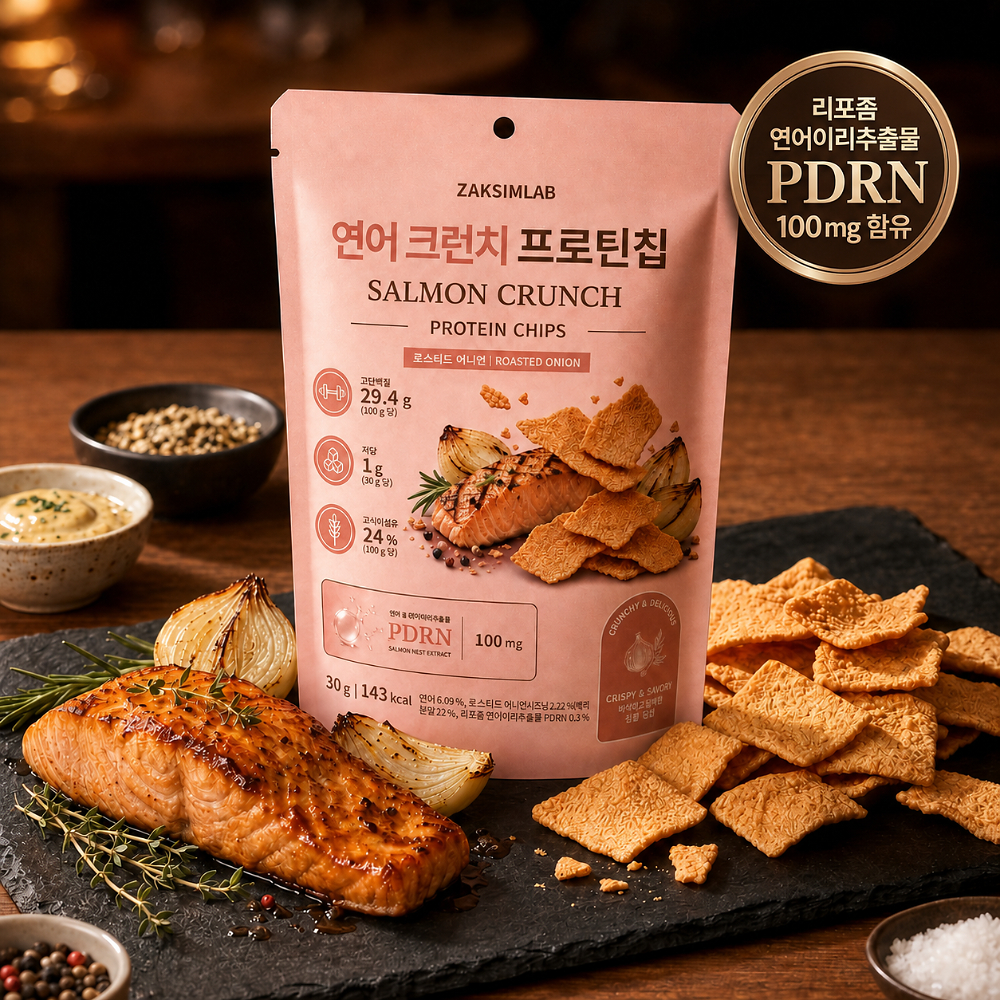
Seoul-based food brand ZAKSIMLAB entered the protein-snack category in September with Salmon Crunch Protein Chips, a roasted-onion-flavored chip made with Alaska pollock surimi, salmon, rice flour from Korean-grown rice, and brown rice oil. The launch extends the brand beyond its core powdered kombucha business and signals a deliberate push into café retail and foodservice distribution channels.
The Product Lineup
The chips are positioned on thin, crispy texture and savory-salty flavor — attributes the company says translate the convenience-first philosophy it applied to its single-serve stick-pack kombucha. That kombucha line spans 12 flavors, including lemon, flat peach, and plum, formulated to mix into still or sparkling water. Together, the two SKUs form the basis of a pairing platform ZAKSIMLAB is now actively selling into the café and specialty-retail tier.
The combined debut came at the 2026 Cafe & Bakery Fair Season 2, held October 29 through November 1 at KINTEX in Goyang, Gyeonggi Province — one of South Korea's highest-traffic foodservice trade events. At its booth, ZAKSIMLAB ran live kombucha tastings alongside salmon chip sampling, using the floor time to introduce café operators and distributors to both beverage-menu applications and in-store snack retail opportunities. The trade-show strategy mirrors a channel approach common in the global better-for-you snack segment, where brands use operator-facing events to shorten the path from production to point-of-sale placement.
Operator and Channel Angle
For café operators, the pitch is a low-friction add-on: stock the chips as a grab-and-go retail item that pairs naturally with kombucha-based beverages already on the menu. ZAKSIMLAB is following up fair contacts with individual consultations to tailor menu applications and supply terms to each account — a standard area-development approach for emerging brands seeking scalable distribution without committing to exclusive agreements.
The brand is also preparing a consumer-facing pairing campaign targeting Millennial and Gen Z adults, centered on kombucha-based highballs served alongside the salmon chips. The campaign is framed around inclusive gathering culture — explicitly accommodating non-drinkers by positioning kombucha as a full-flavored, non-alcoholic alternative. That framing aligns with broader foodservice trends covered here on functional beverages and the sober-curious daypart, where operators are reworking evening menus to capture consumers who want complexity without alcohol.
The protein-snack angle is equally timely. Alaska pollock surimi has gained traction as a cost-effective, high-protein seafood ingredient in better-for-you snack innovation, and its use here positions the chips within a category that has outpaced conventional salty snacks on unit velocity in convenience and specialty retail. Domestically, ZAKSIMLAB says it will broaden purchase options so consumers can build their own kombucha-and-chip combinations, suggesting a bundle or variety-pack SKU strategy is on the horizon.
No revenue figures, distribution footprint, or unit economics were disclosed in conjunction with the launch.
Written by Michael Politz, Author of Guide to Restaurant Success: The Proven Process for Starting Any Restaurant Business From Scratch to Success (ISBN: 978-1-119-66896-1), Founder of Food & Beverage Magazine, the leading online magazine and resource in the industry. Designer of the Bluetooth logo and recognized in Entrepreneur Magazine's "Top 40 Under 40" for founding American Wholesale Floral, Politz is also the Co-founder of the Proof Awards and the CPG Awards and a partner in numerous consumer brands across the food and beverage sector.