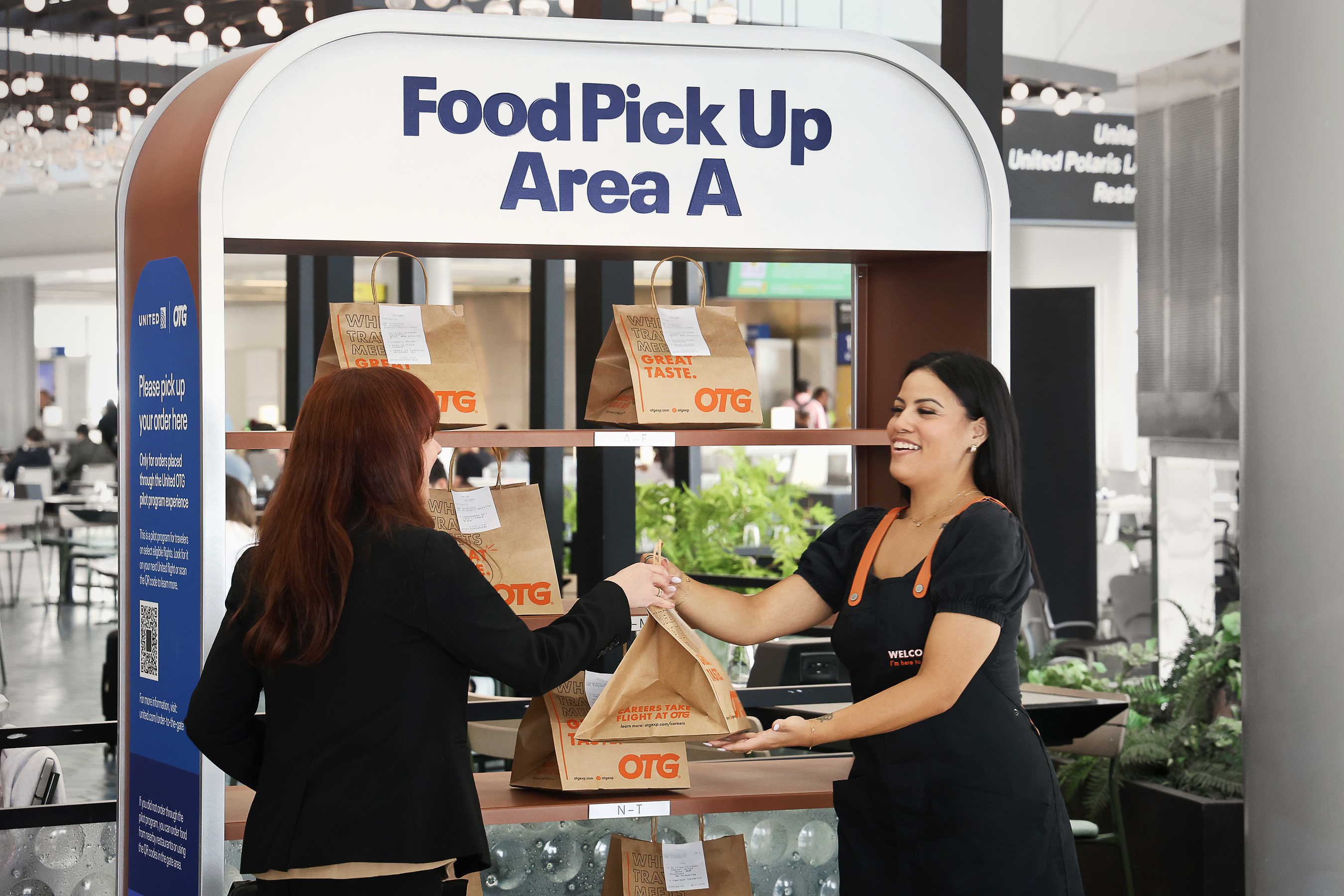
United Airlines (NASDAQ: UAL) has launched a gate-delivery food and beverage pilot at Newark Liberty International Airport, letting travelers pre-order meals, snacks, drinks, and travel essentials through the United app and collect them from a designated pickup shelf before boarding — no terminal sprint required.
The Pilot Setup
The program is live on select flights departing from or connecting through up to nine gates in Terminal C (C125–C138), which handle both domestic and international narrow- and widebody departures. United is partnering with airport hospitality operator OTG to source and stage orders from participating concessions including Nonna's Kitchen and Victory Grill. The assortment spans sandwiches, salads, kids meals, chips, candy, and beverages, alongside convenience items such as over-the-counter medicine, travel pillows, and charging cords. Customers receive a pre-departure push notification via the app or email when the ordering window opens.
For airport foodservice operators, the arrangement represents a meaningful shift in how concession volume gets captured. Rather than competing for foot traffic in the pre-board rush, participating restaurants fulfill pre-committed orders through OTG's logistics layer — a model closer to off-premise aggregation than traditional grab-and-go retail.
Why Newark, Why Now
David Kinzelman, United's Chief Customer Officer, cited the hub's high connecting volume as the driver: "Newark is a high-volume connecting hub where customers often have limited time between arriving at the gate and boarding, making it an ideal place to pilot this type of service." Connecting passengers — who face compressed dwell times and uncertain gate locations — represent exactly the daypart gap that traditional airport concession layouts struggle to serve efficiently.
The pilot is also part of a broader airline digital investment cycle. United has been rolling out Starlink Wi-Fi across its fleet and expanding app functionality with tools like a TSA wait-times tracker. Integrating pre-departure F&B ordering into that same digital surface gives the airline a stickier use case for the app while generating a new data stream on passenger food preferences by route and daypart.
Expansion and Operator Implications
United plans to extend the pilot to Houston before the end of 2026, and the Houston iteration will add national restaurant brands and offer the option of direct-to-gate delivery in addition to shelf pickup. If the program scales further, United intends to fold ordering into seatback inflight entertainment screens — a move that would blur the line between pre-departure and in-flight foodservice, and could reshape how airport restaurant operators think about order flow, staffing, and ticket-size.
For the broader airport foodservice segment, the United pilot signals growing airline appetite to own the pre-board F&B experience rather than cede it to terminal landlords. OTG — already one of the most digitally sophisticated airport concession operators in North America — is a logical launch partner, given its existing technology infrastructure and multi-brand restaurant footprints at major hubs. Operators watching this space should note that airline-controlled ordering surfaces could eventually compress the impulse-purchase dynamic that drives margin at traditional airport grab-and-go units, even as they open new guaranteed-order volume for kitchen partners willing to plug into the fulfillment chain.
Written by Michael Politz, Author of Guide to Restaurant Success: The Proven Process for Starting Any Restaurant Business From Scratch to Success (ISBN: 978-1-119-66896-1), Founder of Food & Beverage Magazine, the leading online magazine and resource in the industry. Designer of the Bluetooth logo and recognized in Entrepreneur Magazine's "Top 40 Under 40" for founding American Wholesale Floral, Politz is also the Co-founder of the Proof Awards and the CPG Awards and a partner in numerous consumer brands across the food and beverage sector.