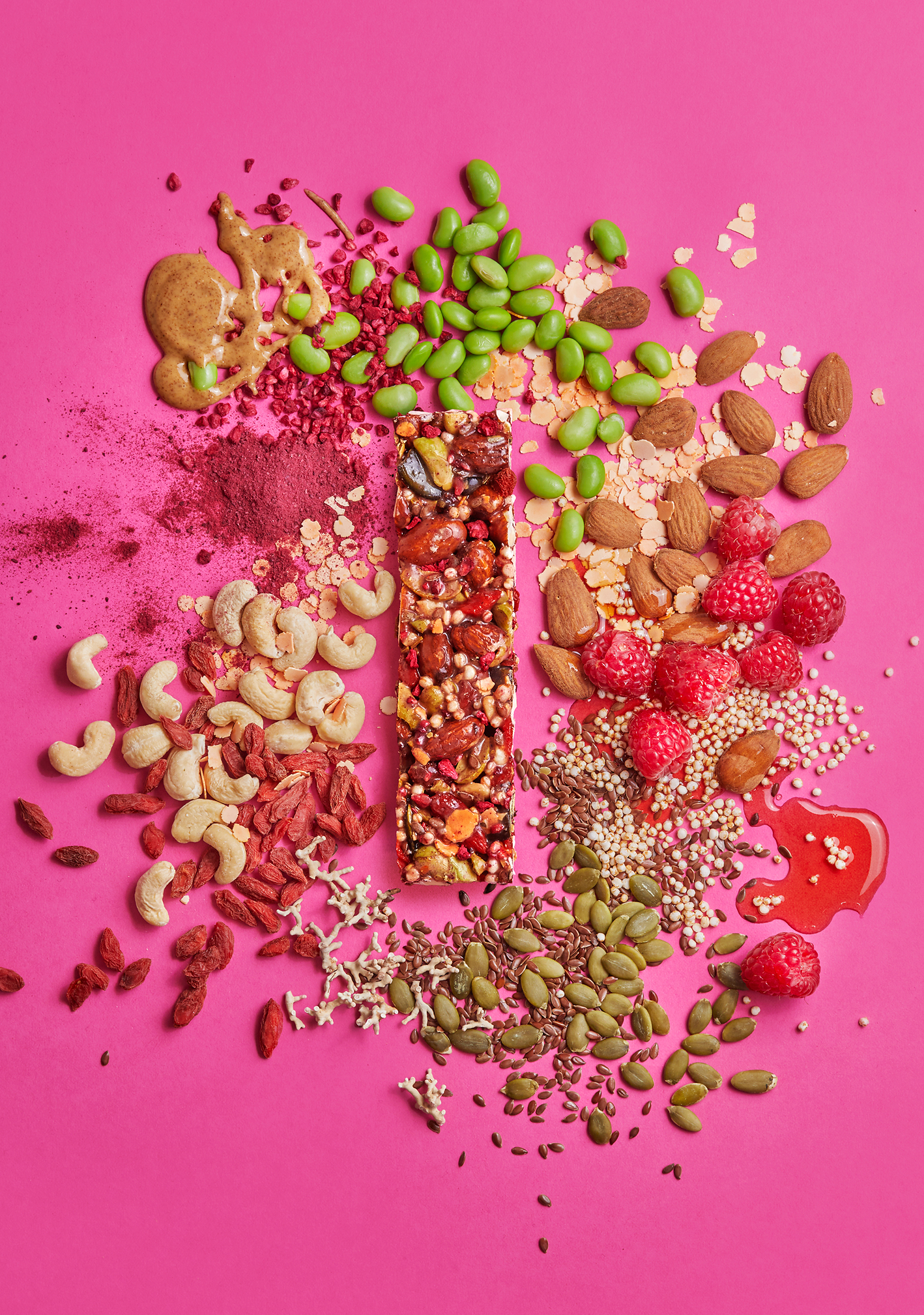
Gut health science company ZOE entered the U.S. snack bar category this week with the launch of its Gut Health Bar, a chewy, whole-plant bar carrying 8g of fiber and 7g of plant protein across more than 10 plant ingredients per bar. The direct-to-consumer launch — priced at $50 per box of 12, or $45 per month on subscription — marks ZOE's first move beyond its app and Daily30 supplement into finished food.
The Product Case
The bar's ingredient deck includes almonds, cashews, edamame, red lentils, flaxseeds, pumpkin seeds, seaweed, and kombucha. ZOE's scientists deliberately preserved the food matrix — the structural integrity of plant ingredients — so components travel further into the digestive tract, feeding gut microbes and extending satiety. The company also sourced an emulsifier-free 70% dark chocolate for one of two launch flavors; the second is Raspberry + Goji Berry. Both positions are aimed at differentiating from conventional bars that rely on ultra-processing and added sugars to hit flavor targets.
Professor Sarah Berry, Chief Science Officer at ZOE and Professor of Nutritional Sciences at King's College London, framed the launch around snack quality rather than frequency. "Snacking itself isn't the issue; it's the quality of what people are eating," Berry said, citing her research linking higher-quality snacks to more favorable markers of metabolic health. The bar's slow-eating design draws on ZOE's PREDICT study data, which found fast eaters consume an average of 120 more calories per day than slow eaters — a reduction in eating speed of roughly 20% correlating to about a 15% drop in energy intake.
Segment & Operator Context
The better-for-you snack bar segment is one of the more crowded aisles in both retail and non-commercial foodservice, with established players ranging from RXBar and Kind to newer functional entrants targeting gut, immune, and metabolic health. ZOE's DTC-first approach sidesteps retail slotting fees and keeps margin intact, but it also limits exposure in the impulse-purchase channels — convenience, college dining, healthcare foodservice — where snack bars generate significant volume. For non-commercial operators and hospitality purchasing teams evaluating better-for-you grab-and-go sets, ZOE's science credential and subscription model may be more relevant as a signal of consumer demand than as an immediate SKU addition.
A ZOE-commissioned survey of 1,000 U.S. adults underlines that demand signal: 64% of respondents said they have felt misled by marketing claims on food packaging, and 69% said clearer guidance on which foods support health would change their food choices. Notably, 70% of the 45% who self-identify as healthy eaters could not name the recommended daily fiber intake — a gap ZOE is explicitly targeting with its 30-plants-a-week messaging.
What's Next
ZOE's bar launch extends the company's broader push to commercialize science from what it describes as the world's largest nutrition study, backed by a microbiome database of more than 300,000 people. Whether the brand pursues wholesale, foodservice distribution, or retail placement beyond ZOE.com has not been disclosed. For the better-for-you snack category, however, a science-first DTC entrant with an established subscriber base and recognizable advisory talent represents a competitive dynamic worth tracking — particularly as operators build out functional snacking options across healthcare, corporate dining, and fitness-adjacent venues.
Written by Michael Politz, Author of Guide to Restaurant Success: The Proven Process for Starting Any Restaurant Business From Scratch to Success (ISBN: 978-1-119-66896-1), Founder of Food & Beverage Magazine, the leading online magazine and resource in the industry. Designer of the Bluetooth logo and recognized in Entrepreneur Magazine's "Top 40 Under 40" for founding American Wholesale Floral, Politz is also the Co-founder of the Proof Awards and the CPG Awards and a partner in numerous consumer brands across the food and beverage sector.