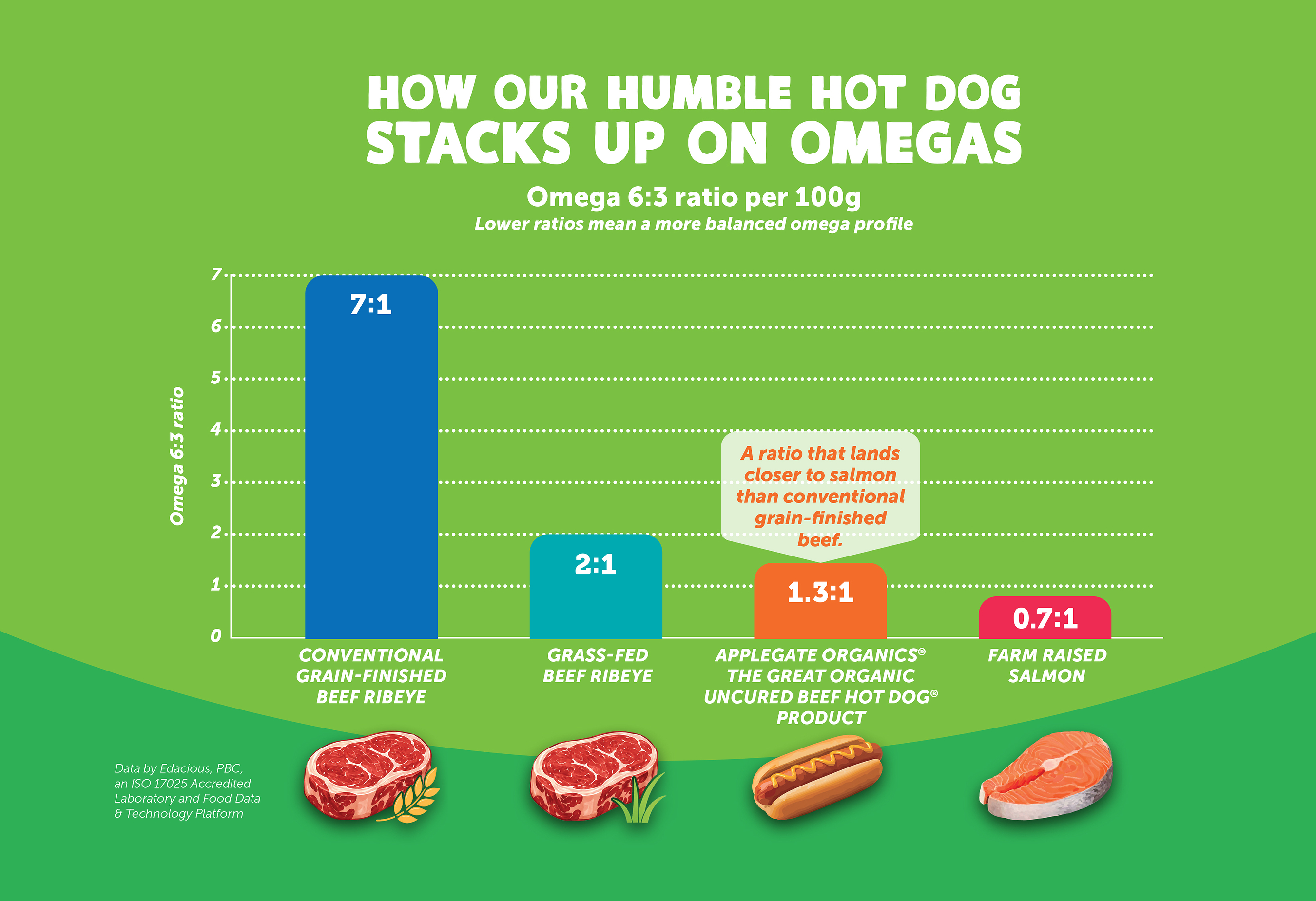
Applegate Farms has released omega fatty acid data showing its Regenerative Organic Certified all-beef hot dog carries an omega-6 to omega-3 ratio of 1.3:1 — significantly tighter than the 7.0:1 ratio recorded for conventional grain-finished beef in the same dataset. The findings, published in the company's 2025–26 Mission Report, represent the first public output of Applegate's Regenerative Health initiative, a research program designed to quantify whether certified regenerative agricultural practices alter the nutritional composition of finished meat products.
The Numbers
Testing was conducted by Edacious, an ISO-accredited laboratory and food data platform, which analyzed omega-6 and omega-3 fatty acid concentrations per 100 grams of product. Applegate's Organics Great Organic Uncured Beef Hot Dog recorded 0.09 g of omega-6 and 0.07 g of omega-3, yielding the 1.3:1 balance. For context, grass-fed beef in the Edacious dataset registered a 2.0:1 ratio, while farm-raised salmon — long regarded as a benchmark omega-3 source — came in at 0.7:1. Some research cites the modern Western dietary pattern at an omega-6 to omega-3 ratio as high as 20:1, making the comparison a pointed one for Applegate's positioning in the better-for-you protein segment. The beef used in the product is 100% grass-fed, pasture raised, and certified under the Regenerative Organic Certified standard.
Supply Chain Implications
For foodservice operators and retail buyers sourcing premium protein, the research signals a potential differentiation lever beyond existing label claims — animal welfare, antibiotic-free, and organic status — that have already driven category premiumization in the natural and organic meat segment. Applegate, a stand-alone subsidiary of Hormel Foods since 2015, markets itself as the nation's leading natural and organic meat brand across hot dogs, bacon, sausages, and deli meats. The Regenerative Health initiative extends that positioning into nutritional science territory, a move that could influence both menu callouts and procurement conversations as operators navigate growing consumer interest in ingredient transparency.
"At Applegate, we have long believed that how food is raised matters," said Joseph O'Connor, president of Applegate. "Through Regenerative Health, we are asking an additional question: How might those practices influence the nutritional characteristics of the food people eat?"
Research Pipeline
The omega fatty acid test is one component of a broader scientific effort. Applegate has also supported a study examining the relationship between cattle production practices and beef nutrient composition, and is separately funding research on whether consuming organic grass-fed beef versus conventionally raised grain-fed beef may positively influence human health outcomes. That study is being prepared for peer review. Carolyn Gahn, senior director of mission and advocacy at Applegate, framed the initiative as a data-generation exercise rather than a finished conclusion: "Our goal is to contribute credible data and support research that helps connect those dots."
For the foodservice supply chain, the initiative is worth tracking on two fronts. First, peer-reviewed findings — if they substantiate the lab data — would give operators sourcing certified regenerative beef a scientifically defensible health narrative alongside existing sustainability and procurement claims. Second, Applegate's methodology, anchored by an ISO-accredited third party, sets a documentation standard that other natural and organic protein brands may feel pressure to match as the better-for-you protein segment continues to expand across both retail and foodservice channels. The company plans to continue testing its certified regenerative beef for omega fatty acids and additional nutritional characteristics.
Written by Michael Politz, Author of Guide to Restaurant Success: The Proven Process for Starting Any Restaurant Business From Scratch to Success (ISBN: 978-1-119-66896-1), Founder of Food & Beverage Magazine, the leading online magazine and resource in the industry. Designer of the Bluetooth logo and recognized in Entrepreneur Magazine's "Top 40 Under 40" for founding American Wholesale Floral, Politz is also the Co-founder of the Proof Awards and the CPG Awards and a partner in numerous consumer brands across the food and beverage sector.