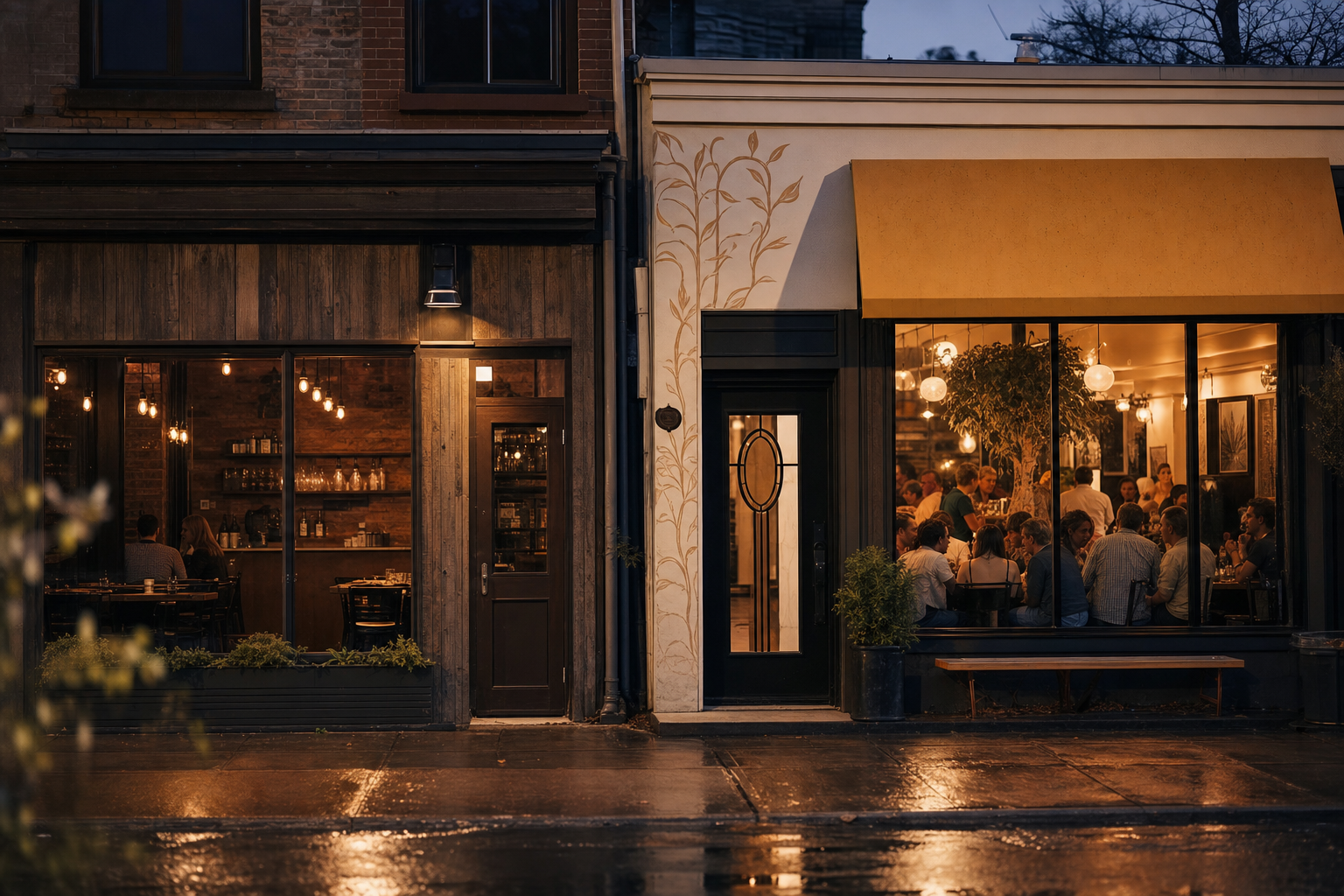
Walk into any competitive restaurant market in 2026 — Nashville, Austin, Charleston, Las Vegas, Brooklyn — and you'll see the same pattern. Twenty concepts within a ten-block radius, all with reclaimed wood, filament bulbs, sourdough on the menu, a smashburger somewhere, and an Instagram grid that could belong to any of them.
The food is genuinely good at most of these places. The service is fine. The prices are within $3 of each other.
And yet one of them is on a two-hour wait every night, and the rest are running Groupons.
The difference isn't the menu. The difference is that one of them has a brand — a clear, defensible identity a guest can describe in a single sentence — and the others have a restaurant.
In Part 1 of this series, we made the case that restaurants are in the attention business. This installment goes one layer deeper: attention without identity is a leaky bucket. You can win the algorithm on Monday and be forgotten by Friday if guests can't say what you actually stand for.
The Data: Identity Is a Revenue Line Item
Branding gets dismissed as the soft part of the business — logos, colors, "vibes." The data says otherwise.
- Consistent brand presentation across all channels increases revenue by 23–33%, according to Lucidpress/Marq's landmark studies of 600+ brand management experts across two waves (Marq, State of Brand Consistency).
- 68% of companies report that brand consistency contributed directly to revenue growth (Lucidpress, 2019).
- A consistent color scheme alone can lift brand recognition by up to 80% (Loyola University color study via Omnibound).
- It takes 5–7 impressions for a consumer to remember a brand — which means the operators posting inconsistent, off-voice content are resetting that counter every week (Omnibound, 2026).
- 87% of consumers say they'll pay more for products from a trusted brand, and 80% now trust brands they use more than they trust government, media, or NGOs (Capital One Shopping / Edelman).
Translate that to a $3M independent restaurant: the gap between a clear, consistently expressed brand and a diluted one is roughly $690K–$990K in annual revenue — before you touch the menu, the buildout, or the marketing budget.
Brand isn't the soft part of the business. It's the highest-leverage line item most operators aren't managing.
Why "Nice Logo + Good Food" Is Not a Brand
The most common branding mistake in the industry is confusing visual assets for brand identity.
A logo is not a brand. A color palette is not a brand. A tagline is not a brand.
A brand is the answer to three questions every guest is unconsciously asking within the first ten seconds of encountering you — on a phone screen, on a sidewalk, or at a host stand:
1. What are you? (Category and promise.) 2. Who is this for? (Am I the guest you're built for?) 3. What do you believe? (Point of view — why you exist beyond serving food.)
If your team can't answer those three questions in the same sentence, your guests can't either. And when guests can't describe you in a sentence, they don't recommend you. Recommendations are how restaurants scale attention for free.
The Three Layers of a Restaurant Brand
Every durable restaurant brand operates on three layers, in this order:
Layer 1 — Worldview. What you believe about food, hospitality, or your city that most of your competitors don't. This is the foundation. Everything else is a tactic.
Layer 2 — Voice. How that worldview sounds. The tone of your captions, your menu descriptions, your voicemail, your emails, your team's on-camera personality. Voice is the connective tissue between a great meal and a memorable one.
Layer 3 — Aesthetic. How the worldview looks. Logo, color, typography, plating, lighting, uniforms, signage, packaging, the grid. This is the layer most operators start with — and it's the least defensible on its own, because aesthetics are copyable in an afternoon.
The order matters. Worldview → Voice → Aesthetic. Operators who invert that stack — starting with a Pinterest board and reverse-engineering meaning — end up with restaurants that photograph well and get forgotten in six months.
Operators who get the order right build brands that survive menu changes, location moves, chef turnover, and platform shifts. Because the brand isn't the plate. The brand is the reason a guest keeps choosing you when the plate changes.
The Napkin Test
Here's a diagnostic we've watched every strong operator pass and every struggling one fail.
Grab a napkin. In one sentence — no more than 15 words — write down what your restaurant is, who it's for, and what it believes.
Now go ask your GM, your head chef, and your last three guests to do the same.
If the five napkins don't roughly match, you don't have a brand problem in marketing. You have a clarity problem at the ownership level — and it's leaking into every hire, every post, every menu decision, and every guest interaction.
Every restaurant on the two-hour wait passes the napkin test. Every one running Groupons fails it.
Case in Point: Identity Out-Earning Footprint
Look at the independent operators quietly outperforming national chains in their markets. The pattern is remarkably consistent:
- A Detroit neighborhood pizza operator with 48 seats out-earns a national chain three blocks away because their entire brand is built around one worldview — "Detroit-style is a regional art form, not a menu item" — and every touchpoint reinforces it.
- A Charleston oyster bar built a national reputation without a second location by making their sourcing story — every oyster tagged to the farmer who pulled it — the visible, repeatable center of the brand.
- A Las Vegas off-Strip concept fills every seat on locals-only marketing because they refused to look like a Strip restaurant, from menu typography to server scripts to the deliberate absence of neon.
None of these operators have the biggest budget in their market. They have the clearest identity. In an attention economy, clarity beats spend every time.
The Brand Clarity Canvas
Here's the seven-question framework we recommend every operator complete — ideally with their leadership team in a room, not in a Google Doc — before their next campaign, renovation, or menu redesign.
1. Worldview. What do we believe about food, hospitality, or our city that most competitors don't? 2. Category. In one word or short phrase, what are we? (Not a description — a category. "Neighborhood chophouse." "Third-wave taquería." "Farm-to-glass wine bar.") 3. Guest. Who is this built for — specifically? (If the answer is "everyone," the brand is for no one.) 4. Enemy. What are we the antidote to? (Every strong brand has an implicit "we're not that." Name it.) 5. Signature moment. What is the one experience a guest can only have here? 6. Voice. If our restaurant were a person at a dinner party, how would they talk? Give three adjectives — and one adjective they'd never be. 7. Non-negotiables. What are the three things we would never do, even if it cost us revenue in the short term?
If the leadership team can answer all seven with the same words — not similar words, the same ones — you have a brand. If not, you have a to-do list.
The Operating Shift
Building identity into a moat isn't a marketing project. It's an operating discipline. Three moves separate the operators who compound identity from the ones who reset it every quarter:
1. Write the brand book. Actually write it. A one-page brand book — worldview, voice, three do's, three don'ts, five sample captions, five off-limits phrases — is the single highest-ROI document a restaurant will ever produce. It turns brand from an opinion into an operating standard.
2. Filter every decision through the brand. New menu item? Does it reinforce or dilute the worldview? New hire? Do they get the voice? New partnership? Does it fit the enemy? Brands aren't built in campaigns. They're built in the hundred small decisions per week that either compound or contradict the identity.
3. Audit quarterly. Once a quarter, pull the last 30 days of posts, the last 30 days of guest reviews, and the current menu. Read them side by side. Do they sound like the same restaurant? If not, you're not being disrespected by the algorithm — you're being disrespected by your own inconsistency.
The Bottom Line
Menus get copied. Locations get replicated. Recipes leak. Chefs move on. Trends rotate every 18 months.
The one asset a competitor cannot reverse-engineer is a brand a guest can describe in a single sentence — because that sentence lives inside the guest's head, not on your wall.
In Part 1, we said restaurants are in the attention business. Here's the refinement: attention without identity is rented. Attention anchored to a clear identity compounds. The operators who understand that difference are quietly building the enterprise value in this industry.
Your menu will change five times before this decade is over. Your brand shouldn't.
Coming next in the series — Part 3: The Content Station. How the smartest operators are turning their kitchens into newsrooms — and producing 10x the content at a fraction of the stress.
Want the Brand Clarity Canvas as a printable one-pager? Subscribe to Food & Beverage Magazine and we'll send it with the next issue. Meet us at the NRA Show for a live workshop with operators putting this framework into practice.