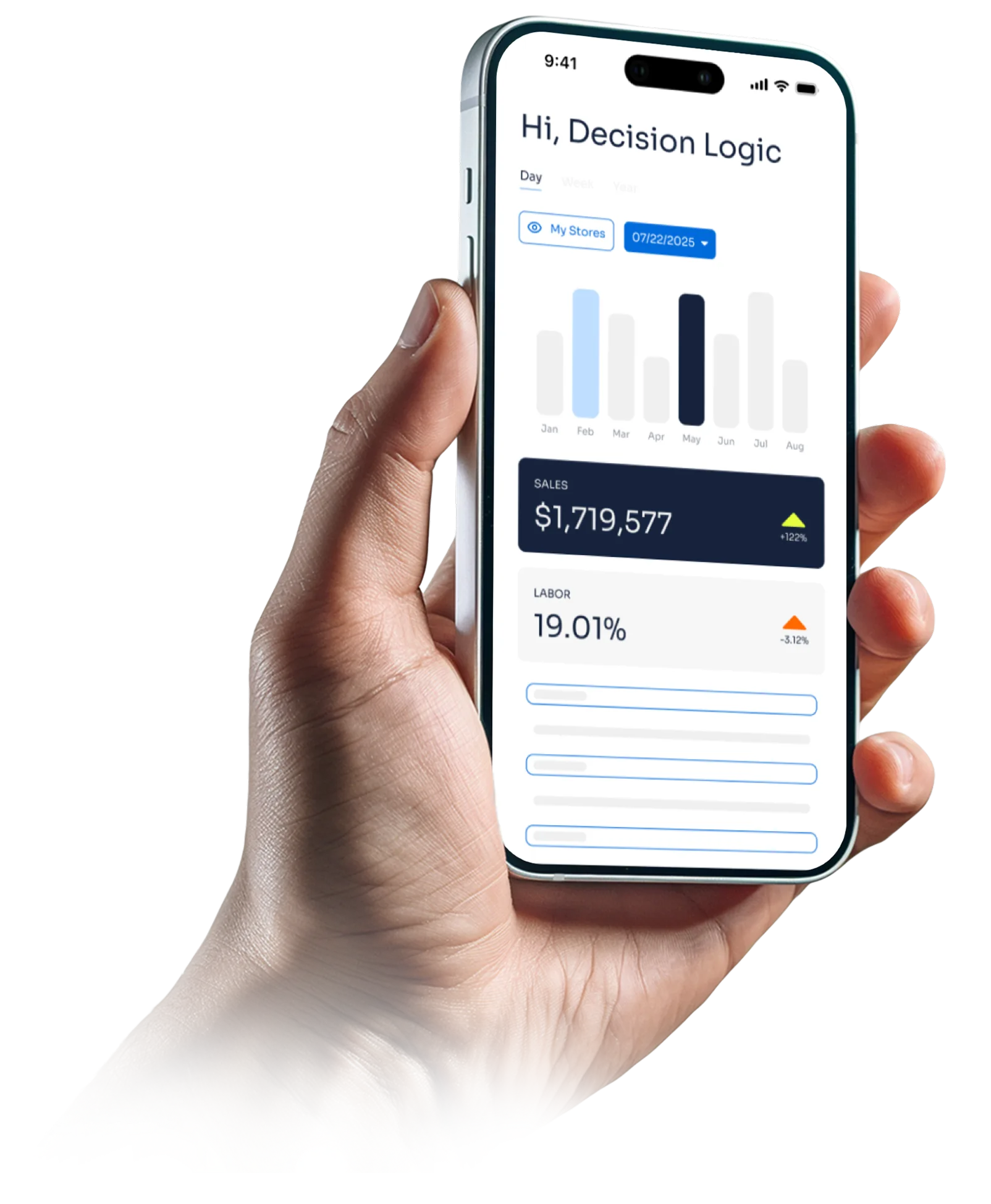
Back-of-house software provider Decision Logic has launched Open Semantic Access, a capability that lets multi-unit restaurant operators pipe their operating data — sales, labor, inventory, food cost — directly into AI tools of their choosing without paying a per-location access fee or waiting on custom report queues.
The release, timed to coincide with FSTEC 2026, positions Decision Logic against a growing category of point-solution AI add-ons that charge operators separately to query their own data. The company estimates the new capability can cut the time from business question to actionable answer by three to four times in applicable use cases.
The Cost Argument
Pricing is the sharpest edge of the announcement. Decision Logic folded Open Semantic Access into its existing platform at no additional charge. The company offers a pointed illustration of the alternative: an AI or API add-on priced at $300 per location would run a 450-unit operator more than $135,000 annually — a figure that compounds with every new opening or acquisition. For growing casual-dining and fast-casual brands already managing tight unit economics, that line item is difficult to justify when the underlying data already lives inside their back-of-house system.
"Restaurant operators shouldn't have to buy their own data back just because they want to use it with AI," said Keegan Conrey, chief executive officer of Decision Logic. "Open Semantic Access is built around a straightforward principle: it's your data. You should be able to use it with the tools you choose, ask the questions that matter to your business and get answers without waiting for someone else's roadmap."
How It Works in Practice
Open Semantic Access gives operators read-only access to their Decision Logic data alongside the semantic definitions that tell an AI tool what the numbers actually mean — distinguishing gross from net sales, or a case quantity from an individual item, before any query begins. That metadata layer is what separates the capability from a raw data export: an AI model arrives pre-briefed on the operator's specific business logic rather than requiring manual data cleaning or schema documentation.
Operators can then route that data into whichever large-language model their team already runs — ChatGPT, Claude, Gemini, or others — rather than being locked into a single vendor's proprietary chat interface. For a multi-unit brand running 100-plus locations, that flexibility matters as the AI landscape continues to shift. Tools that work today may be superseded by new models inside 18 months; Open Semantic Access is designed so the underlying data access layer remains stable while the AI layer turns over.
Practical use cases cited by Decision Logic include ideal-versus-actual menu item performance, true guest traffic analysis, and margin modeling built directly on live operating data. Tasks that previously required a developer, a business intelligence team, or weeks on a reporting backlog can instead be framed as natural-language queries against the operator's own dataset.
Operator Footprint
Decision Logic's current client roster includes 54th Street Restaurants, RibCrib BBQ, Golden Corral, Taco John's, and Twin Peaks — a mix of regional casual-dining and bar-and-grill concepts where food cost variance and labor optimization carry outsized margin impact. Those segments have faced persistent pressure from elevated commodity costs and wage inflation, making faster access to actual-versus-theoretical data a tangible operational lever rather than a technology novelty.
The broader back-of-house tech segment has seen increased M&A and platform consolidation as restaurant groups evaluate integrated versus best-of-breed approaches to restaurant technology. Decision Logic's no-fee, bring-your-own-AI positioning is a deliberate counterpoint to bundled-platform vendors that monetize AI access as a premium tier.
Open Semantic Access is available now. Operators can request a live demonstration at decisionlogic.io/demo or visit the Decision Logic booth at FSTEC 2026. For context on how operators are weighing AI investment against unit-level cost controls, the calculus increasingly favors vendors who treat data portability as table stakes rather than a paid upgrade.
Written by Michael Politz, Author of Guide to Restaurant Success: The Proven Process for Starting Any Restaurant Business From Scratch to Success (ISBN: 978-1-119-66896-1), Founder of Food & Beverage Magazine, the leading online magazine and resource in the industry. Designer of the Bluetooth logo and recognized in Entrepreneur Magazine's "Top 40 Under 40" for founding American Wholesale Floral, Politz is also the Co-founder of the Proof Awards and the CPG Awards and a partner in numerous consumer brands across the food and beverage sector.