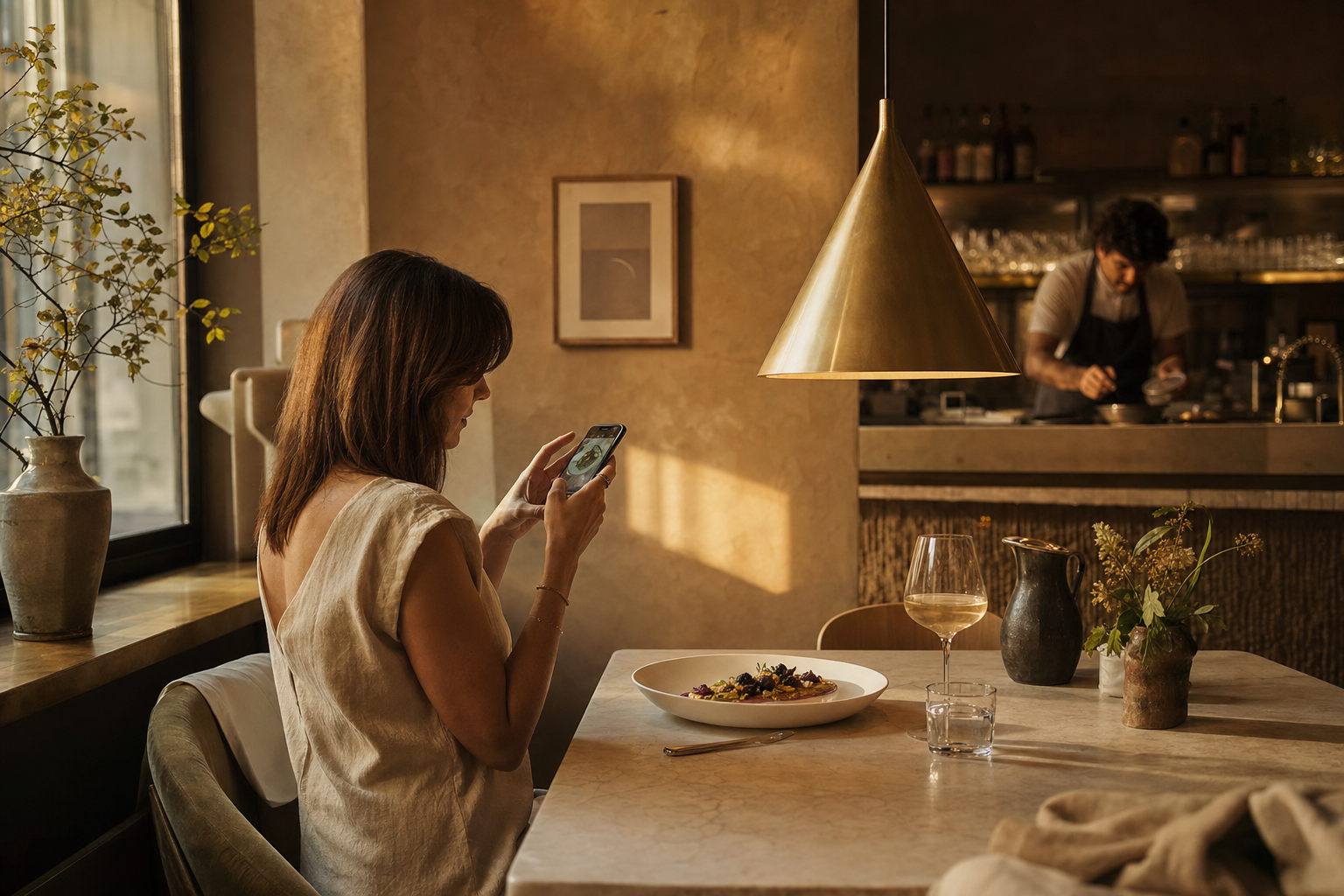
A veteran restaurant designer said something on a panel last year that most operators in the room quietly bristled at, then thought about for six months.
"If your dining room can't be shot vertically on a phone at 6:47 p.m. in November, you don't have a design problem. You have a business problem."
The bristle is understandable. Nobody who spent $1.4 million on a buildout wants to hear that the highest-value question about their space isn't how it feels, but how it films. But the number that matters is this: 55% of diners are more likely to visit a restaurant after seeing a menu item video, and 65% of consumers actively search for tagged restaurant posts before visiting (Web Tonic, 2026; XtendedView, 2026).
Your physical restaurant isn't just a dining room anymore. It's a content set — the film location where your entire attention strategy either compounds or breaks. The operators pulling ahead have stopped resisting that and started designing for it.
The Data: The Camera Is Already in the Room
Whether or not you designed for it, guests are filming.
- 55% of diners share photos of meals on Instagram (Gitnux, 2026).
- UK Gen Z and 71% of UK Millennials say they consider a restaurant's Instagram- or TikTok-worthiness important when deciding where to dine (Joli, 2026).
- Video-equipped landing pages generate 83% more conversions than non-video equivalents (Web Tonic, 2026).
- User-generated content reposts increase trust by 92%, and restaurants featuring UGC see up to 29% higher engagement than branded-only content (Gitnux, 2026; XtendedView, 2026).
- Adding a 360° virtual tour to a Google Business Profile lifts bookings by up to 42% (Web Tonic, 2026).
- Behind-the-scenes kitchen visuals account for roughly 29% of all restaurant TikTok content (Web Tonic, 2026).
The camera isn't optional. Every guest and every team member is carrying one. The only decision left to operators is whether the space they're standing in was designed to make that footage work.
The Reframe: Set Design, Not Just Interior Design
Interior design and set design are related disciplines that answer different questions.
Interior design asks: How will this space feel to a guest sitting in it for 90 minutes?
Set design asks: How will this space film for 15 seconds on a vertical phone screen, under actual restaurant lighting, at the exact hour service peaks?
The best restaurants have always answered the first question well. The ones winning the attention economy answer both — and when the two are in conflict, they let the set-design answer win, because the film outlasts the meal.
This doesn't mean building an "Instagram trap." Neon signs saying "you had me at hello" age fast, feel corporate, and read as inauthentic on camera. It means designing every surface a phone will see with the same rigor you gave the wine list.
The Seven Shareable Surfaces
Every restaurant has seven surfaces guests are filming, whether you designed them for it or not. Audit each one honestly.
1. The Pass / Kitchen Line. The single highest-value content surface in most restaurants. If guests can see plates being finished — with proper light and a clear sightline — you have a permanent, always-running content engine. 29% of restaurant TikTok content is behind-the-scenes kitchen for a reason (Web Tonic, 2026). If your pass is hidden or badly lit, you're leaving the most valuable footage in the building on the table.
Audit questions: Is there a sightline from at least a portion of the dining room to the pass? Is there dedicated lighting on the plate at the moment of finish? Is the counter surface photogenic — or a scuffed stainless top from 2011?
2. The Signature Dish Presentation. Every restaurant needs at least one dish designed as much for the plate-drop moment as for the palate. This is the dish that gets filmed the most, tagged the most, and reserved for. It doesn't have to be gimmicky — smoke, torching, tableside carving, pouring, cracking — but it does have to be repeatable, timed, and lit.
Audit questions: What is our signature moment? Can every server execute it consistently? Is it happening in enough light to film?
3. Lighting at the Table. Most restaurant lighting is designed for ambiance — warm, low, moody. Ambiance lighting eats food photography alive. The best operators are running two lighting systems: ambient warmth from the walls and fixtures, and a discreet, higher-CRI (color rendering index) downlight at each table that hits the plate cleanly. Guests read the room as warm. The camera reads the plate as vivid.
Audit questions: Is the plate itself lit, or just the room? Do phones need to be tilted to catch color? Are colors on the plate reading true, or muddy?
4. The Entryway / First 10 Seconds. The vertical video that will become your most-viewed piece of content this year is almost certainly the one shot in the first ten seconds a guest walks in. Host stand, door frame, entry vignette, first sightline into the dining room. If the entry is transactional and forgettable, so is the video.
Audit questions: What does the first vertical frame look like? Is there a signature detail — a mural, a bar wall, a maître d' station — that anchors the shot?
5. The Bar. Bars film better than dining rooms. Backbar bottles, glassware, a bartender pouring, ice being spanked, a cocktail being finished tableside — this is where a huge portion of tagged content originates. And bars scale better on video than food does: one great cocktail moment can produce content for months.
Audit questions: Is the backbar composed as a shot? Is there room behind the bar for a phone angle? Is the cocktail garnish moment happening in decent light?
6. The Bathroom. Yes, really. The bathroom is one of the most-photographed rooms in any restaurant, precisely because it's usually the only place a guest is alone with their phone and a fresh backdrop. Bathrooms with intentional design — a wall treatment, a mirror moment, a scent, a graphic detail — are how restaurants win unpaid, guest-generated content while their competitors are still hanging generic art.
Audit questions: Is our bathroom a set piece or an afterthought? What is the shareable detail? What color reads on camera?
7. The Menu Itself. Guests film menus. Constantly. As tags, as reference, as a way of saving "I want to come back and try this." A menu that photographs well — clean typography, a coherent visual system, real hierarchy — becomes a piece of shareable content every time it's flipped open. A menu that photographs badly is a piece of anti-content every time it hits the table.
Audit questions: Does the menu look composed on a vertical phone frame? Would you post a photo of it if you weren't the operator? Are prices, descriptions, and typography working together?
The Signature Moment Test
Beyond the seven surfaces, every strong restaurant brand has at least one repeatable, camera-ready signature moment — an experience that only happens here and that guests can't help but film. Examples we've seen work:
- A tableside caviar service on a copper spoon.
- The bread arriving under a smoked glass cloche that lifts at the table.
- A "chef's greeting" at the pass that every VIP guest can request.
- A specific pour — a wine, a coffee, a shot of amaro — that becomes the closer for every meal.
The test: could a guest describe, in one sentence, a physical moment that only happens at your restaurant? If yes, that moment is your content flywheel. If no, that's the top priority coming out of the audit.
The pattern that separates strong signature moments from gimmicks: signature moments serve the meal. The bread is better under the cloche. The caviar is better on the copper. The amaro is better as the closer. Anything designed purely for the camera reads as insincere on the camera it was designed for.
The Renovation Math
The most common pushback we hear on this framework: "We can't afford a renovation."
Fair. But two things are true simultaneously.
One: Most of the audit above requires no renovation. Lighting adjustments, menu redesign, pass sightline changes, bathroom refresh, signature-moment implementation — all of this is achievable in a $5,000–$25,000 window, not a $500,000 one.
Two: For operators who are renovating anyway — the average full-service restaurant renovates roughly every 7–10 years — folding these questions into the design brief adds ~2–5% to the budget and can materially move future revenue. In an environment where video-equipped landing pages convert 83% better (Web Tonic, 2026) and 42% of bookings can lift on the strength of a Google 360° tour alone, that math is easy.
Design for the camera before the buildout. It's exponentially cheaper than retrofitting.
The Owner's Filter: Would I Film This?
There's a diagnostic every operator can run tonight, with no budget and no consultant. Walk your restaurant during service — from the front door, to the host stand, through the dining room, up to the bar, past the pass, into the bathroom, back to a random table. Pull out your phone. Film 10 seconds vertical at each stop.
Then watch the reel back.
You'll see, immediately, which of your seven surfaces are working and which aren't. You'll see where the light dies. You'll see which corners are killing color. You'll see whether the entry moment lands or falls flat. You'll see what a guest sees — and, more importantly, what a guest films.
That 10-minute exercise is the highest-leverage audit most operators will run this quarter. The next 10 minutes should be spent writing down the three fixes you can execute this week.
The Bottom Line
The camera is already in your dining room. Every night. In dozens of hands.
The operators winning the attention economy have stopped pretending that's an interruption of the guest experience and started treating it as part of the guest experience — one they design for as intentionally as they design the wine list or the plating.
Your restaurant is a film location. Your seven shareable surfaces are your soundstages. Your signature moment is your recurring shot. The camera will roll whether you're ready or not.
The only question is whether the footage that reaches your future guests was directed by you — or accidental.
Coming next — Part 8: Crisis, Controversy, and the Attention Downside. The same channels that build a restaurant in a week can dismantle one in a day. The 60-minute rule, the 3 crisis archetypes, and the recovery arc every operator should have written before they need it.
Want the 7 Shareable Surfaces Audit as a printable one-pager? Subscribe to Food & Beverage Magazine for the download. Meet us at the NRA Show for the "Restaurant as a Content Set" walk-through with operators redesigning for the camera.