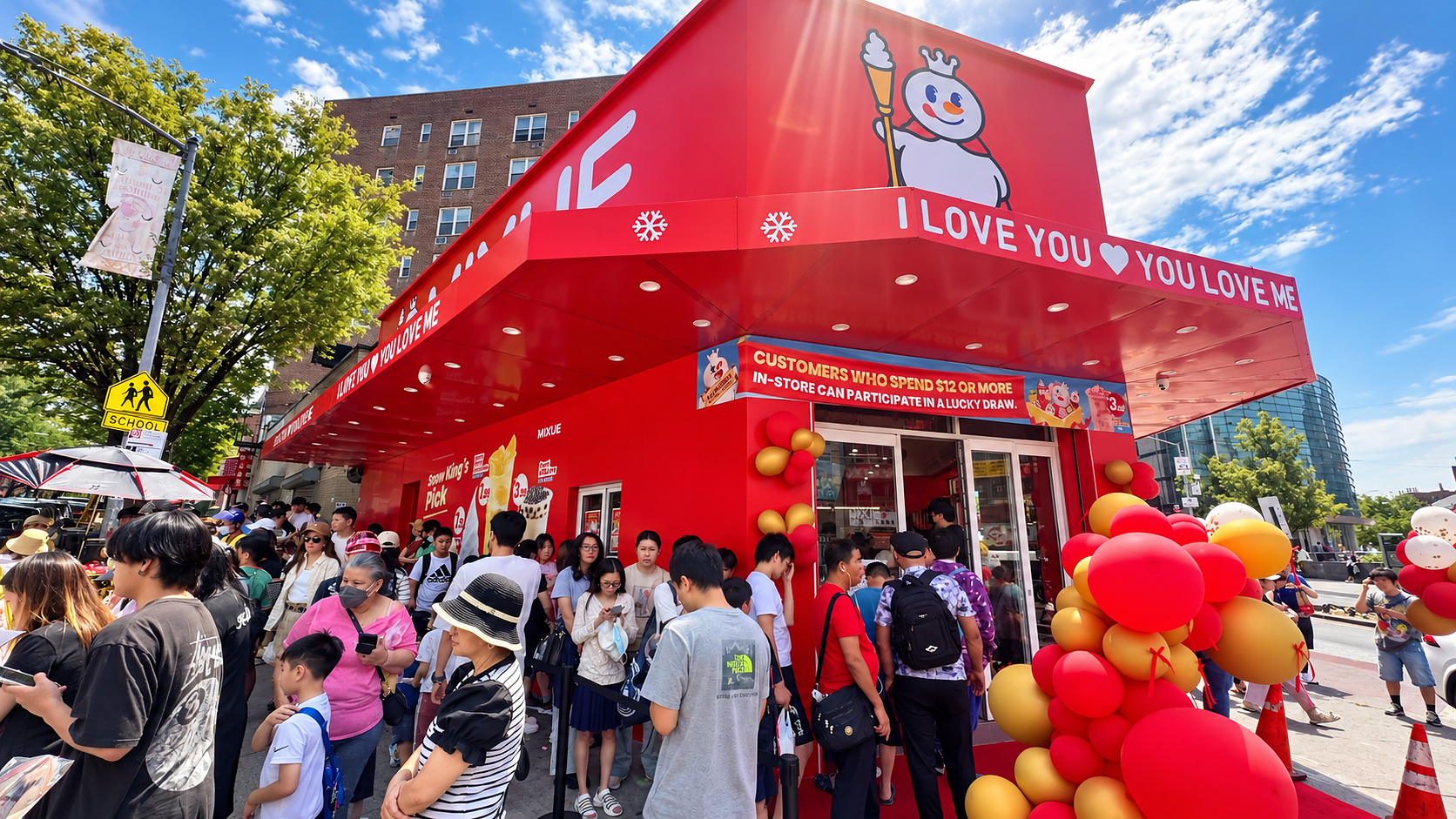
Hong Kong-listed MIXUE Group (02097.HK) pushed six seasonal menu items through its U.S. locations this summer, marking the domestic debut of Green Lemon Tea and Green Lemonade as the fast-growing beverage chain works to establish a value-tier beachhead in the American specialty-tea daypart.
The Product Play
The limited-time lineup leaned into fruit-forward flavor profiles, with the banana-anchored Banana MIXUE Shake and Creamy Banana drawing social-media traction and peer-to-peer sharing that the company says contributed to measurable store-traffic lift. The six-item drop is Mixue's most substantive U.S. menu event since its initial domestic store opening, signaling that the brand is moving beyond proof-of-concept and into iterative LTO cadence — a standard growth tool for scaled beverage chains.
Mixue's core unit-economics proposition centers on keeping menu prices within everyday-purchase range by leveraging an end-to-end supply chain built at scale in China, covering procurement, production, logistics, R&D, and quality control. That integrated sourcing model, rather than ingredient trade-downs, is what the company argues allows it to undercut competitors on ticket without compressing product quality — a claim that will face increasing scrutiny as U.S. unit count grows and local labor and occupancy costs become a larger share of the P&L.
Market Context
The U.S. specialty-tea and ready-to-drink tea segment is a compelling entry point. Iced tea remains the dominant format domestically, but fruit-infused beverages and health-oriented tea hybrids are pulling younger consumers away from carbonated soft drinks and into the category across all dayparts — not just breakfast. That consumer shift has intensified competition among boba chains, regional tea concepts, and coffeehouse operators adding tea SKUs.
By store count, Mixue is already the world's largest freshly-made beverage and food chain — a scale advantage that few specialty-beverage entrants can match on supply-chain leverage. The challenge in the U.S. market is translating that operational efficiency into competitive unit economics in a labor market and real-estate environment structurally different from its core Asia-Pacific base. How quickly the brand can layer a franchise or area-development-agreement structure onto its early corporate-store presence will largely determine the pace of domestic unit growth. For context on how other international beverage chains have approached that transition, see our coverage of franchise development trends in the beverage segment.
What's Next
Mixue has signaled continued U.S. store openings alongside ongoing menu innovation, aiming to embed the brand into everyday refreshment occasions rather than position it as a premium or novelty destination. Consumer-expressed interest in seeing the chain reach additional U.S. markets — surfaced through social channels — suggests aided brand awareness is building, though unaided recognition outside existing store trade areas will require sustained marketing investment.
For foodservice operators and multi-unit investors tracking the value-beverage space, Mixue's U.S. expansion arc is worth monitoring: the brand's ability to hold price discipline while growing domestic unit count will test whether an Asia-scaled supply chain can functionally subsidize Western market entry costs. Comparable dynamics have played out across the fast-casual beverage category as chains with large international footprints have attempted to replicate their home-market economics in North America.
Written by Michael Politz, Author of Guide to Restaurant Success: The Proven Process for Starting Any Restaurant Business From Scratch to Success (ISBN: 978-1-119-66896-1), Founder of Food & Beverage Magazine, the leading online magazine and resource in the industry. Designer of the Bluetooth logo and recognized in Entrepreneur Magazine's "Top 40 Under 40" for founding American Wholesale Floral, Politz is also the Co-founder of the Proof Awards and the CPG Awards and a partner in numerous consumer brands across the food and beverage sector.