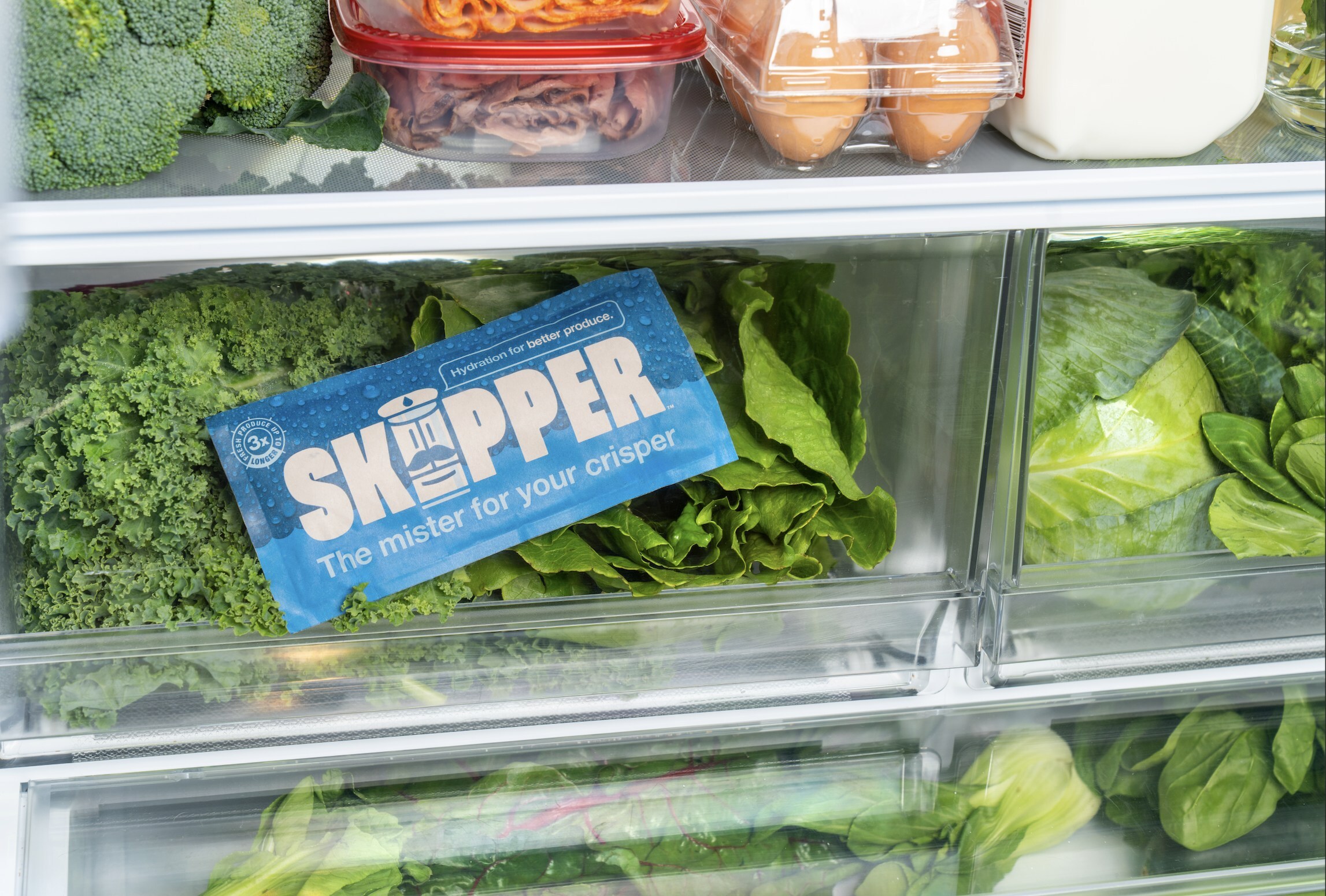
A new consumer brand called Skipper is entering the food-preservation category with what it calls Fridge Hydration, a humidity-management solution the company says can extend fresh-produce shelf life up to three times beyond conventional refrigeration. The launch, announced June 2 out of Minnetonka, Minn., frames temperature-only refrigerator design as a decades-long oversight and positions moisture control as the missing variable.
Skipper has not disclosed AUV-equivalent retail pricing, distribution footprint, or commercial-channel SKUs, but the underlying problem the product addresses is well-documented in foodservice unit economics. Fresh-produce shrink — driven by premature wilting and spoilage in walk-ins and prep coolers — represents one of the more stubborn line items on a commissary or fast-casual operator's P&L. Industry benchmarks have long placed total food waste at 4%–10% of purchased inventory, with leafy greens and cut vegetables among the highest-shrink categories.
The humidity gap Skipper identifies maps directly onto the cold-chain challenge facing operators running high-volume salad, grain-bowl, and fresh-sandwich programs. Standard reach-in and walk-in coolers are engineered for temperature precision; relative humidity inside those units often drops well below the 90%–95% range that most leafy produce requires to maintain cell turgor and visual quality through a full daypart rotation. For multi-unit operators sourcing pre-cut produce on area development agreement timelines — where distribution windows can stretch 48–72 hours — even incremental humidity improvement at the unit level can reduce reorder frequency and trim waste costs.
The consumer-market entry point is notable. Brands that prove a preservation concept at retail have occasionally translated the technology into foodservice-grade hardware, a pathway seen previously in antimicrobial packaging and modified-atmosphere storage. Whether Skipper pursues a commercial-channel variant — sized for undercounter refrigeration, prep-table inserts, or crisper-drawer retrofits in commissary lines — remains to be seen. The company has not announced foodservice distribution partnerships or operator pilot programs.
For chain buyers and procurement directors tracking fresh-program economics, the Fridge Hydration concept is worth monitoring as a potential off-premise and in-unit shrink-reduction tool. The broader fresh-food and cold-chain segment has attracted significant investment since the pandemic reset consumer expectations around produce quality, and waste-reduction technology continues to draw operator attention as input costs remain elevated. Skipper's commercial viability in foodservice will ultimately depend on whether the system can be validated at the speed and scale that multi-unit operators require.
Written by Michael Politz, Author of Guide to Restaurant Success: The Proven Process for Starting Any Restaurant Business From Scratch to Success (ISBN: 978-1-119-66896-1), Founder of Food & Beverage Magazine, the leading online magazine and resource in the industry. Designer of the Bluetooth logo and recognized in Entrepreneur Magazine's "Top 40 Under 40" for founding American Wholesale Floral, Politz is also the Co-founder of the Proof Awards and the CPG Awards and a partner in numerous consumer brands across the food and beverage sector.