Ask most restaurant owners why they don't post consistently and you'll get one of three answers.
"We forget." "We're too busy during service." "Nobody on the team is good at that stuff."
All three answers share the same root cause: content isn't assigned. It has no station, no prep list, no expected output, no one on the hook for it. So it lives in the same purgatory as ordering takeout for the staff — someone probably should, nobody actually does.
Meanwhile, your competitor down the street — the one on the two-hour wait we talked about in Part 2 — treats content the way you treat the sauté station. Someone owns it every shift. There's a prep list. There's a daily output expectation. And by the end of the week, there are 25+ pieces of raw material feeding a machine that fills the dining room next weekend.
That's not a marketing difference. That's an operating difference. And it's the difference this installment is going to close.
The Reframe: Content Is a Station, Not a Task
In a kitchen, "sauté" isn't a task. It's a station. It has a defined footprint, a defined toolset, a defined output, and a defined person responsible per shift. You wouldn't run service by hoping someone remembers to make the risotto. You engineer it.
Content works the same way. When operators stop treating it as a task ("someone should post today") and start treating it as a station ("who's on content tonight?"), three things happen in the first 30 days:
- Output goes up 5–10x without adding headcount.
- Quality goes up, because the work is happening in real time — during service, not from memory the next morning.
- Staff resistance drops, because the ask is a defined shift responsibility, not "extra work."
The data backs the operating shift. Restaurants that post short-form video consistently see engagement lifts of 2.5x over static posts, and behind-the-scenes kitchen content boosts engagement by up to 40% over standard promotional posts (Web Tonic, 2026). Food content on TikTok earns a 4.2% engagement rate — more than double Instagram's rate and 23x Facebook's (Web Tonic, 2026). And 58% of TikTok users have visited or ordered from a restaurant after seeing it on the platform, up from 38% in 2022 — a 20-point jump in two years (Joli, 2026).
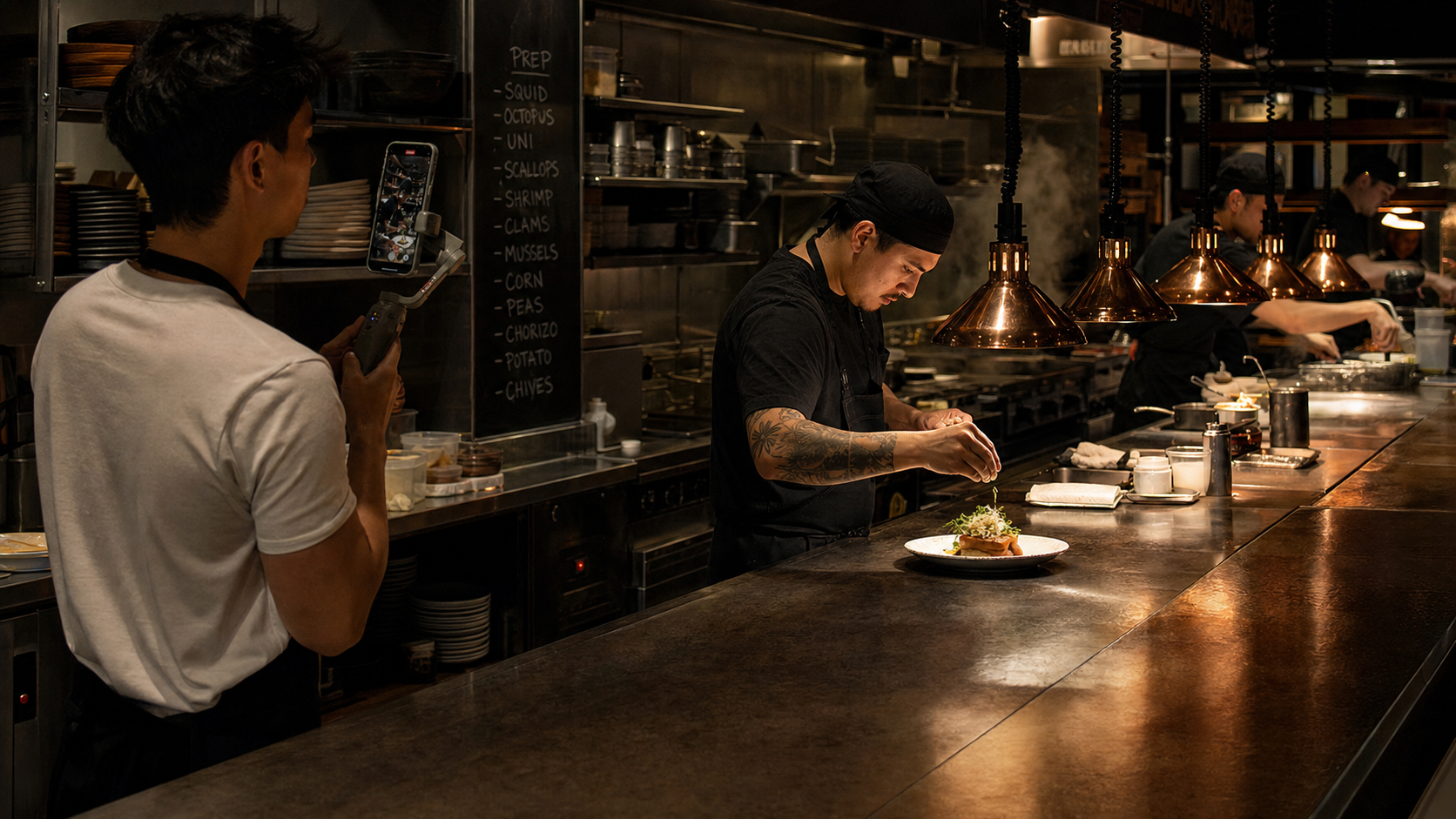
Behind-the-scenes kitchen content is the single most popular restaurant format on TikTok — accounting for roughly 29% of all restaurant TikTok content (Web Tonic, 2026). The camera you need to win is already inside your kitchen. You just have to assign someone to pick it up.
The Daily Capture Checklist: 5 Assets Per Shift
Here's the operating standard that separates restaurants producing content weekly from those producing it constantly. Every shift, the content station captures a minimum of five raw assets. Not five posts — five pieces of raw material. Anyone on the team can shoot them on a phone in under 90 seconds each.
1. One prep shot. A cook slicing, plating, torching, saucing. Vertical. 10–15 seconds. No talking necessary. 2. One "hero dish" moment. The plate being finished right before it hits the pass. This is your algorithmic bait. 3. One human moment. A server laughing, a bartender pouring, the owner tasting a new dish. This is the difference between a restaurant and a brand. 4. One "why" moment. Someone briefly explaining why — why this ingredient, why this technique, why this dish is on the menu. 15 seconds max. 5. One guest moment. A reaction shot, a table clinking glasses, a first bite. Always with permission, always tagged if possible.
Five assets a shift × 14 shifts a week (lunch and dinner) = 70 raw assets per week. Even if only 20% become published posts, that's 14 posts a week from a single 20-minute-per-day operating change. Most restaurants publish 3–5 times a week and consider themselves "active."
Who Runs the Station
The most common mistake here is defaulting the content station to the owner or the marketing person. Both are wrong.
The owner is the wrong choice because they're the most expensive labor in the building and their attention should be on the guest experience during service.
The dedicated marketing person — if you have one — is the wrong choice because they're not in the kitchen when the interesting moments happen. By the time they hear about it, the moment is gone.
The right choice is one of three people, depending on your operation:
- A designated front-of-house manager who runs the floor and captures during natural downtime.
- A promoted line cook or bartender with a comp adjustment ($2–5/hour bump) for owning the content station.
- A part-time content shift (15–20 hours/week) hired specifically for this work — typically a hospitality-native videographer at $25–35/hour who works two prime shifts.
Whichever model you choose, three rules are non-negotiable: one person per shift, a written capture list, a phone with cloud sync to a shared folder. No cloud sync means the content dies on a personal device. No written list means people forget.
The Story Bank Beats the Content Calendar
Content calendars go stale. By the time you fill in "Tuesday: post the fall menu," you've committed to a piece of content whether or not you actually have something worth posting.
The operators pulling ahead use a story bank instead. A story bank is a living document — a Google Doc, a Notion page, a note on the wall — that lists every angle, ingredient, staff bio, sourcing story, seasonal moment, technique, and signature detail worth telling. It's not scheduled. It's available.
A working story bank should have:
- 10 dish origin stories (why this dish exists on this menu)
- 10 ingredient stories (the farm, the producer, the seasonality)
- 5 staff bios (from dishwashers to sommeliers — nobody is off-limits)
- 5 signature techniques (the smoker, the fermentation program, the daily bread)
- 5 recurring rituals (family meal, pre-service tasting, closing walk-through)
- 5 guest moments (regulars, first dates, celebrations, industry drop-ins)
- 10 seasonal or calendar hooks (holidays, sports, local events)
- 10 "myth-busters" (misconceptions about the cuisine, the region, the restaurant)
That's 60 durable stories, each of which can be told through 3–5 raw assets, each of which can be cut into 2–3 finished posts. That's 360 potential posts from one 90-minute leadership session — enough content for a full year at 7 posts a week.
The Weekly Rhythm
The operating cadence that ties the station and the story bank together is a weekly 30-minute content review — ideally Monday morning, ideally the same three people every week.
Agenda (fixed):
- 5 minutes — Review last week's numbers. Reach, saves, profile visits, and reservation clicks per post. Which formats worked? Which flopped?
- 10 minutes — Pull the best raw assets from the week's captures. Rank the top 10. Kill the rest.
- 10 minutes — Match those 10 assets to story bank angles. Assign editing (in-house or outsourced).
- 5 minutes — Set the story bank priorities for the coming week. What are we deliberately capturing?
Half an hour a week. That's the operating overhead of turning your restaurant into a media property that produces daily.
The Bottom Line
The restaurants dominating attention in 2026 aren't spending more on marketing. They're spending more thought on operations. They've quietly reorganized around the truth that in an attention economy, content isn't downstream of the restaurant — it is the restaurant, in the only form 94% of your future guests will ever encounter before they book.
Assign the station. Write the capture list. Build the story bank. Run the Monday review. That's the entire system. It costs you no food, no equipment, and about 20 minutes a day.
The alternative is continuing to hope somebody remembers to post — and losing the market to the operator who stopped hoping.
Coming next — Part 4: Your Team Is Your Talent Roster. Why the line cook with 40,000 TikTok followers is worth more than a billboard, and how to structure comp, contracts, and creative freedom so team-generated content becomes a compounding asset.
Want the Daily Capture Checklist and Story Bank template as printable one-pagers? Subscribe to Food & Beverage Magazine. Meet us at the NRA Show for a live content-station workshop with operators already running the system.